
Blog
Prove one product-development workflow, benchmark answer quality, govern risk, and reach an expand, adjust, or stop decision in 90 days.

An enterprise AI pilot should not end with “users liked it” or “the demo was impressive.” It should end with a decision: expand, adjust, or stop.
What should a 90-day AI pilot for product development prove? It should prove that one bounded workflow can improve speed or quality without weakening source traceability, permissions, review, or human accountability—and establish whether the operating model is ready to scale.
That requires more than turning on software. The pilot must test a real product-development workflow, the evidence needed to support it, the controls required to govern it, and the economic mechanism expected to improve.
The purpose of a pilot is not to prove that AI can produce an answer. It is to determine whether the organization can trust, adopt, and realize value from a better operating method.
Agree on eight things before implementation begins:
Good first workflows include customer-specification review, gate-review preparation, product-requirements development, compliance or claims-evidence assembly, and technical-question resolution. Avoid a low-consequence showcase task. It may produce attractive output without testing the controls and adoption the business will actually require.
For an NPI team, preparing the documents needed to advance a product can be a concrete starting point. An industrial equipment manufacturer used Narratize to generate epic charters, requirements summaries, test plans, and launch briefs in minutes from its product knowledge. That example gives a pilot a recognizable unit of work: turning existing technical context into a useful development document that the team can review.
Complete security, privacy, quality, and legal scoping against the bounded use case before loading data. The AI security checklist for product development provides a practical approval packet.
Begin with the live foundation required to prove the workflow:
Narratize is also expanding self-service workflow and agent administration, guided asynchronous expert interviews, native PowerPoint generation, deeper enterprise connector orchestration, live regulatory and workflow alerts, and advanced Portfolio Intelligence. A pilot can include an in-build capability when its delivery timing, scope, acceptance criteria, and fallback are explicit. It should not make the core value case depend on an uncontracted later-roadmap feature.
Create a Product Knowledge Hub around the selected product, program, or decision context. Load only the sources needed for the first workflow—not the entire archive.
For each consequential source, identify:
Configure the stages, required inputs and outputs, roles, permissions, review points, and hub instructions. Narratize supports reusable workflows today and is expanding broader self-service configuration so hub and group administrators can manage more of that operating model directly.
Run a known-answer test before asking users to trust open-ended work. Include questions with clear support, missing evidence, conflicting sources, and a superseded revision.
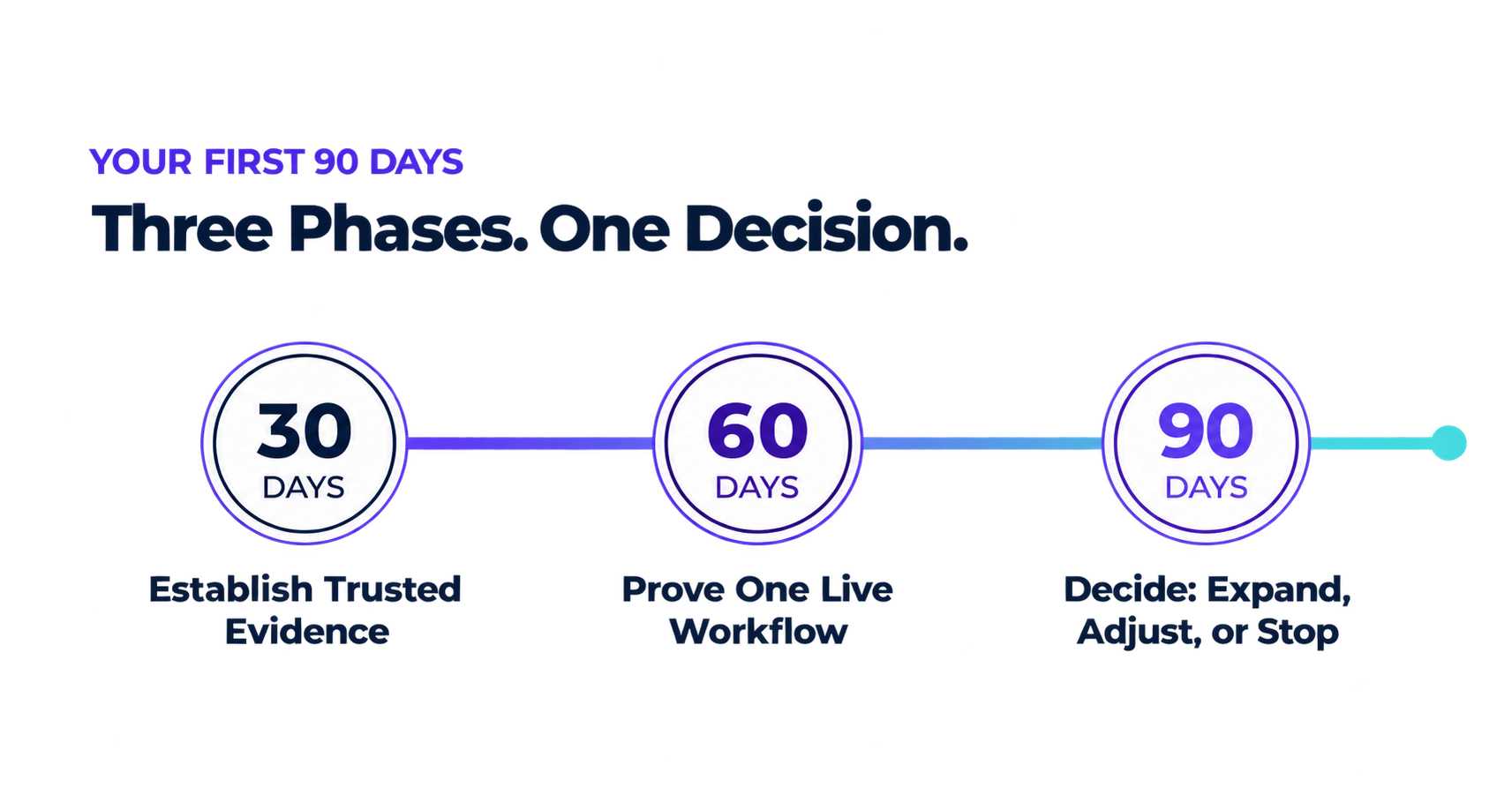
Day-30 acceptance criteria:
The success marker is not “the team asks the hub first.” It is that the hub has earned that behavior on a defined evidence set.
Move the selected work into the hub using the organization’s actual template, review questions, and decision process. Do not flatten the methodology to make the pilot easier.
For example, a specification-review pilot should:
Run a parallel or benchmark comparison where feasible. Record active labor time, elapsed time, reviewer corrections, missed issues, false positives, rework, and the proportion of eligible cases actually completed with the new method.
Day-60 acceptance criteria: at least one real case has completed the full workflow; accountable reviewers have accepted or rejected the output using defined criteria; and the team can reconstruct the sources, edits, approvals, exceptions, and decision.
Once the core workflow is stable, add only the evaluations that matter to the decision. That may include Alignment Checker for cross-document conflicts, the Red Team Agent for assumptions and pre-mortems, Compliance Verification for a defined framework, StageGate Decision and Readiness for a gate recommendation, IP Landscape for patent questions, or Market Intelligence for a changing external assumption.
When the workflow exposes missing rationale, use a targeted expert question or structured interview now. A pilot scheduled alongside the guided-interview release can also test contextual follow-up, expert-facing completion, and knowledge capture—provided the release state is explicit.
When external change matters, define how current Market Intelligence work and emerging live regulatory alerts will route a signal to an owner and disposition. When the workflow ends in a committee or customer presentation, define whether the live document and gate-deck workflow is sufficient or whether native PowerPoint generation will be included as an in-build deliverable. When executive visibility matters, distinguish pilot measures available from current hubs and workflows from advanced portfolio analytics delivered through the in-build Portfolio Intelligence layer.
Then evaluate value against the goals defined before kickoff. The AI business case for product development connects engineering capacity, faster decisions, and knowledge reuse to practical customer examples.
Labor hours, elapsed time, throughput, rework, handoffs, and wait states.
Material gaps found, reviewer corrections, missed issues, false positives, evidence sufficiency, and decisions changed or strengthened.
Source traceability, permission tests, version and approval completeness, exception handling, connector behavior, and audit reconstruction.
Eligible cases using the workflow, active users by role, completion rate, workarounds, capacity redeployed, and benefit-owner acceptance.
Do not collapse these into a single pilot score. A workflow can be fast but unreliable, accurate but too burdensome, or popular without producing economic value. The decision needs all four views.
Begin with the simplest connection pattern that proves the workflow. Current options include point-in-time cloud files, Jira, Confluence, and Aha! content, direct uploads and URLs, and MCP access. Define which system remains authoritative and how currentness will be maintained.
Use Power Automate or deeper connector orchestration when its scope and timing are part of the implementation. Treat direct PLM, ERP, LIMS, QMS, CRM, and two-way synchronization as system-specific architecture work, not a generic checkbox. The product-development tech-stack guide provides the ownership and data-flow model.
End with a concise record:
An honest “adjust” or “stop” is a successful pilot outcome. It prevents an organization from scaling a workflow whose evidence, controls, or economics are not ready.
Expand along the same value chain before broadening access indiscriminately. Convert the pilot into a repeatable blueprint, prove it with a second team, connect the adjacent systems and functions, and introduce Portfolio Intelligence only when program definitions and evidence standards are comparable.
The 12-month AI adoption roadmap sequences self-service configuration, guided expert interviews, enterprise connectors, alerts, PowerPoint generation, and advanced portfolio analytics behind explicit expansion gates.
Bring one workflow, one completed benchmark set, and the baseline data already available. Narratize can turn them into a 90-day pilot contract with explicit acceptance and expansion criteria. Plan the pilot.
Schedule a demo and watch your team's expertise become intelligence the whole organization can use.