
Blog
Scale from one proven workflow to self-service configuration, enterprise connectors, live alerts, cross-program knowledge, and portfolio analytics.

Enterprise AI programs often try to move directly from an impressive pilot to organization-wide access. That is usually too fast for the operating system and too slow for the business: the platform spreads before evidence, ownership, and governance are ready, while valuable workflows remain trapped in experimentation.
How should manufacturers scale AI for product development? Scale in four evidence-gated phases: prove one consequential workflow, make the operating model repeatable, connect adjacent teams and systems, and then add portfolio-wide intelligence. Expansion should follow verified value and governance readiness—not seat count.
The 12-month roadmap below is not a promise that every organization will follow the same calendar. It is a sequence for matching adoption with the capabilities, data, and controls each stage requires.
The goal is not to deploy AI everywhere. It is to build a repeatable system in which product evidence, expert knowledge, workflow, and decisions become more valuable as adoption expands.
Write down:
Separate the deployment roadmap from the product roadmap. A sound adoption plan can use live capabilities first, add contracted in-build capabilities when available, and avoid making the business case depend on directional future features.
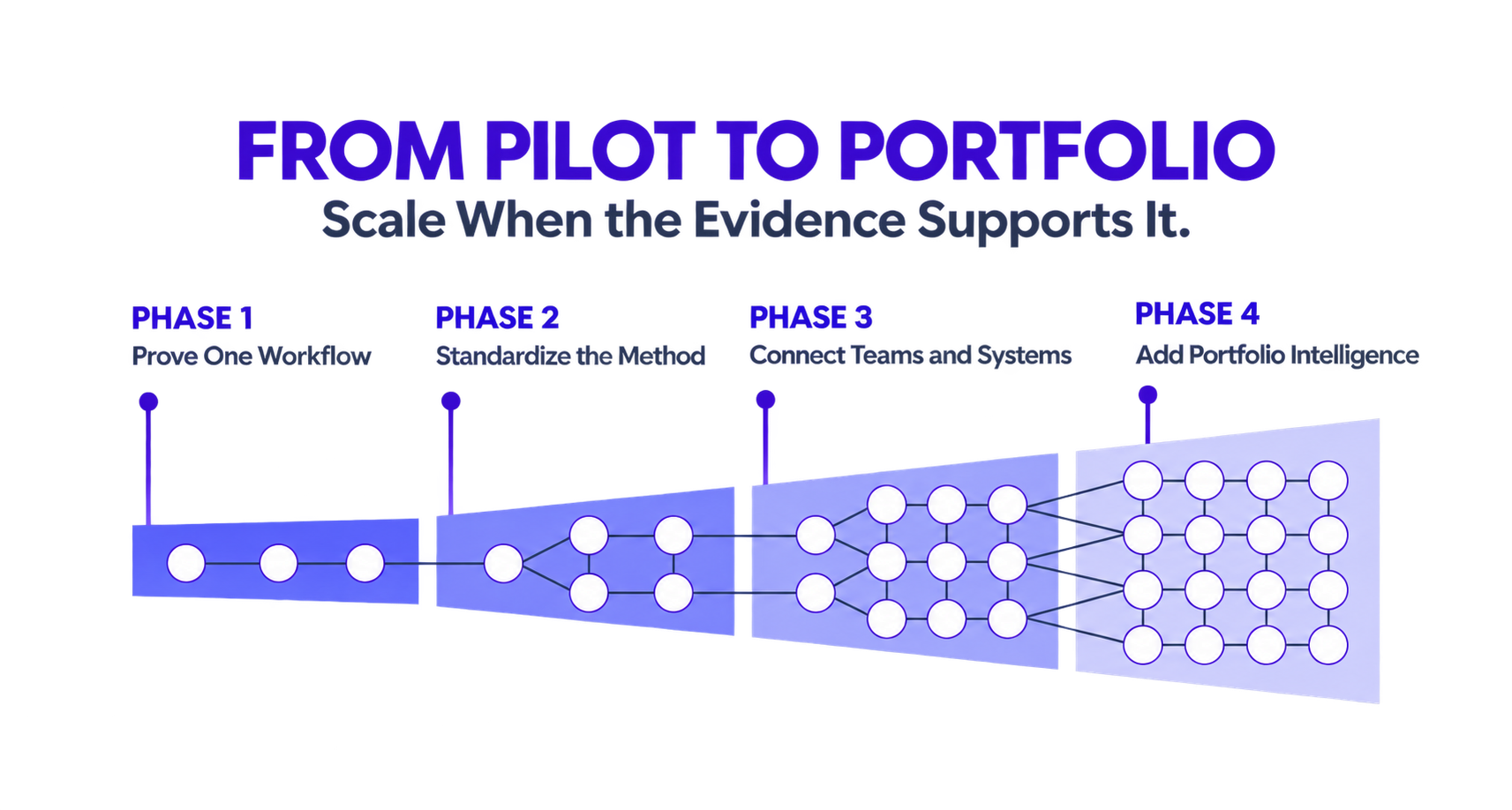
Choose one repeated, consequential workflow with a clear unit of work. Strong starting points include customer specification review, gate-review preparation, PRD development, compliance evidence assembly, or technical question resolution.
Use the capabilities available now:
Test completed benchmark cases before a live decision depends on the workflow. Track labor, elapsed time, reviewer corrections, misses, false positives, evidence quality, adoption, and control behavior.
Expansion gate: at least one live case completed end to end; accountable reviewers accept the output standard; the team can reconstruct sources, edits, approvals, and decisions; and the benefit owner accepts the measured result.
The 90-day AI pilot plan provides the detailed acceptance criteria.
Do not add departments yet merely because the first workflow worked. First convert the pilot into an operating pattern.
Standardize:
Narratize is expanding self-service workflow and agent configuration so hub and group administrators can build, assign, and manage more of this operating model directly. This allows validated patterns to scale without turning every change into a bespoke implementation project.
Guided asynchronous expert interviews are also in build. They extend today’s targeted questions and interview templates with categorized question banks, scheduling, contextual follow-up, expert-facing completion, and governed knowledge capture. Use them first for expertise directly tied to a live product decision—not broad “capture everything before retirement” programs.
Native PowerPoint generation is in build as another repeatability layer. Gate packs, customer reviews, program updates, and executive narratives can be rendered as editable decks from governed hub knowledge instead of being rebuilt manually.
Expansion gate: a second team can run the workflow from the documented blueprint; role-based onboarding works; required evidence and reviews are clear; and the measured value remains material outside the original champion group.
Expand along a value chain, not an org chart. Examples:
This phase tests whether the knowledge and decision record can survive handoffs across functions.
Use current connections for point-in-time cloud files, work-management content, direct uploads, URLs, and MCP access. Add Power Automate and deeper connector orchestration as contracted in-build capabilities become available. Scope direct PLM, ERP, LIMS, CRM, QMS, formulation, and other system connections against specific objects and workflows rather than promising universal synchronization.
For every connection, define the authoritative system, data objects, direction of movement, refresh behavior, permissions, failure handling, and destination of approved outputs. The product-development tech-stack guide provides the architecture model.
Expiration and approval alerts provide a live foundation. Narratize is expanding workflow, stage-gate, integration, compliance, and live regulatory alerts. Connect each alert to a product context, owner, required disposition, and decision deadline. Avoid a new feed that users learn to ignore.
Expansion gate: at least one cross-functional process is operating end to end; authoritative-system boundaries are documented; connector and alert failures have owners; and reuse across teams produces measurable value without violating access controls.
Portfolio Intelligence is in build as the executive layer above Product Knowledge Hubs. Its near-term design includes:
Advanced portfolio analytics should be introduced only after enough hubs use comparable definitions. Otherwise, the dashboard creates false comparability across programs that still mean different things by “ready,” “validated,” or “high risk.”
Use the portfolio layer to answer operating questions:
Native PowerPoint generation can turn the governed portfolio view into an editable operating or board deck. The presentation should remain a rendering of the current state, with the ability to trace a signal back to the source hub and decision.
Expansion gate: leaders trust metric definitions, can drill into the evidence behind a signal, and use the portfolio view to make at least one documented allocation, escalation, or stop decision.
Use three levels:
Owns the business constraint, removes barriers, and makes expansion decisions. The sponsor should not be measured on license adoption alone.
Representatives from product, R&D or engineering, quality or regulatory, IT and security, business operations, and affected commercial functions. The council sets data, workflow, agent, evidence, and change standards.
Workflow owners define the operating method and accept its outputs. Hub stewards maintain source quality, metadata, permissions, and lifecycle hygiene. These may be part-time roles, but they must be explicit.
Track four dimensions:
Logins, chats, generated documents, and hubs created can diagnose behavior. They are not the program’s economic outcome.
A credible report includes:
Use the six board-ready NPD metrics and the AI business case for product development to keep the discussion attached to business value.
Bring the target workflow portfolio, current systems map, and 12-month business priorities. Narratize can sequence live capabilities, near-term releases, integration work, and adoption gates into a credible expansion plan. Plan the adoption roadmap.
Schedule a demo and watch your team's expertise become intelligence the whole organization can use.