
Blog
See where Narratize fits beside PLM, ERP, QMS, LIMS, PPM, CRM, and document systems as the intelligence and decision layer for NPD.
Advanced manufacturers already have systems of record for product definitions, transactions, quality, laboratory work, projects, customers, and documents. The persistent gap is the work between those systems: understanding why a decision was made, reconciling evidence across functions, carrying prior learning into a new program, and turning fragmented records into a defensible next action.
Where does Narratize fit in the New Product Development/New Product Innovation tech stack? Narratize is the governed intelligence and decision layer for new product development. It works alongside PLM, ERP, QMS, LIMS, PPM, CRM, and document systems, connecting the records those platforms own with expert knowledge, decision rationale, workflow context, and source-traceable AI.
Systems of record preserve what happened. Narratize helps product teams understand what it means, what is missing, and what to do next.
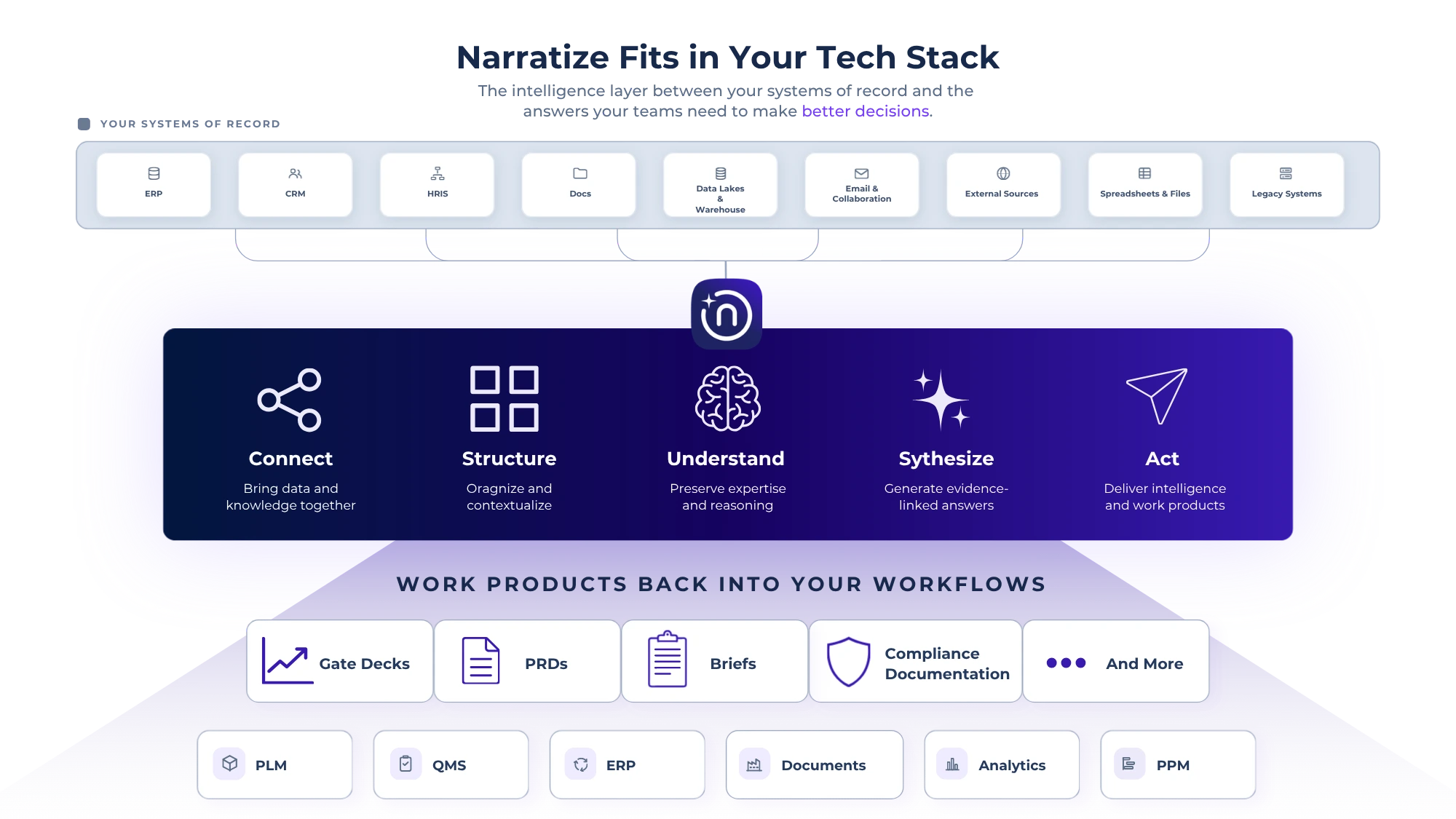
A sound architecture keeps each enterprise platform authoritative for the records it is designed to govern.
Controlled product definitions such as parts, bills of material, specifications, configurations, engineering changes, and released revisions.
Transactions and execution data such as purchasing, inventory, orders, costs, production, and financial postings.
Controlled quality processes and records such as nonconformances, CAPA, audits, complaints, training, and quality-document control.
Laboratory samples, methods, experiment records, raw data, and controlled results.
Portfolio prioritization, budgets, resources, schedules, milestones, and project status.
Customer, opportunity, account, and commercial-interaction records.
File storage, coauthoring, communication, and day-to-day collaboration.
Narratize does not need to become the canonical owner of all these records to improve the decisions that depend on them. Its role is to preserve source identity and assemble the relevant context for product-development work.
Product-development decisions require a combination no single system typically owns:
This is not merely unstructured data waiting to be summarized. It is the reasoning layer that lets teams interpret the structured records they already own.
A Product Knowledge Hub creates a governed working context for a product, program, research area, or recurring decision. It can hold source material, authored and generated work, expert contributions, metadata, workflow stage, review state, versions, and document lineage.
Teams use that context to:
The unit of value is not the file or the chat. It is the product decision and the evidence thread behind it.
Narratize supports several enterprise connection patterns now:
Connected storage remains authoritative; Narratize creates the governed context needed for the selected product workflow. Today’s cloud-storage connections are point-in-time rather than automatic live synchronization, so every implementation should define source ownership and refresh responsibility.
Narratize is expanding its Integration Layer beyond current source connections and MCP. Near-term work includes deeper connector orchestration and Power Automate support. The broader direction includes direct PLM, ERP, LIMS, and specialized enterprise connections; no-code integration; controlled pull-and-push workflows; and agent outputs surfaced in the systems where teams already work.
That roadmap can support environments built around systems such as Windchill, Teamcenter, SAP, NetSuite, Uncountable, LabWare, Veeva, and Egnyte. The exact connection pattern should be scoped by system, use case, security model, and delivery timing rather than reduced to a generic “integrates with everything” claim.
Organization-level workflow templates, hub inheritance, stage inputs and outputs, document-to-stage association, readiness indicators, flexible advancement, approvals, and override history are available today. Stage-gate, agile, and hybrid methods can be configured around the organization’s terminology and decision logic.
Narratize is extending self-service workflow and agent administration so hub and group leaders can configure more of that operating model directly. It is also adding richer timeline, checklist, and milestone views, role- and stage-aware suggestions, and bottleneck detection.
Purpose-built agents already available include Alignment Checker, Compliance Verification, Research, Market Intelligence, Market Readiness and Launch, the named Red Team Agent, IP Landscape, Size of Prize, Funding Opportunity, High-Impact High-Unknown, StageGate Decision and Readiness, and Knowledge Gap assessment.
Teams can capture targeted expert answers inside a workflow today, structure interviews with templates, and ingest transcribed audio and video as source-linked knowledge. Narratize is extending this into guided asynchronous expert interviews that use categorized question sets, contextual follow-up questions, due dates, expert-facing flows, and governed knowledge objects.
Source-grounded documents, Word and PDF export, gate-deck templates, and editable content workflows are available now. Native PowerPoint generation is in build so approved hub knowledge can become an editable presentation with charts, diagrams, and evidence context instead of being reconstructed slide by slide.
Portfolio Intelligence is also in build as the executive layer above Product Knowledge Hubs. It is designed to provide cross-hub health views, stage progression, evaluation summaries, knowledge-readiness scoring, reliability signatures, natural-language portfolio questions, and drill-down to the evidence behind each signal.
No. Narratize complements them.
These questions produce a more credible deployment than “connect all our data.” They also create a clear value test: can the intelligence layer improve a decision the existing stack cannot support on its own?
Bring the current architecture diagram and one cross-system workflow. Narratize can map canonical ownership, evidence movement, governance, and connector requirements. Schedule a stack-mapping session.
Schedule a demo and watch your team's expertise become intelligence the whole organization can use.