Blog
Scope data, access, models, evidence controls, enterprise connectors, operations, and exit before approving AI for product development.

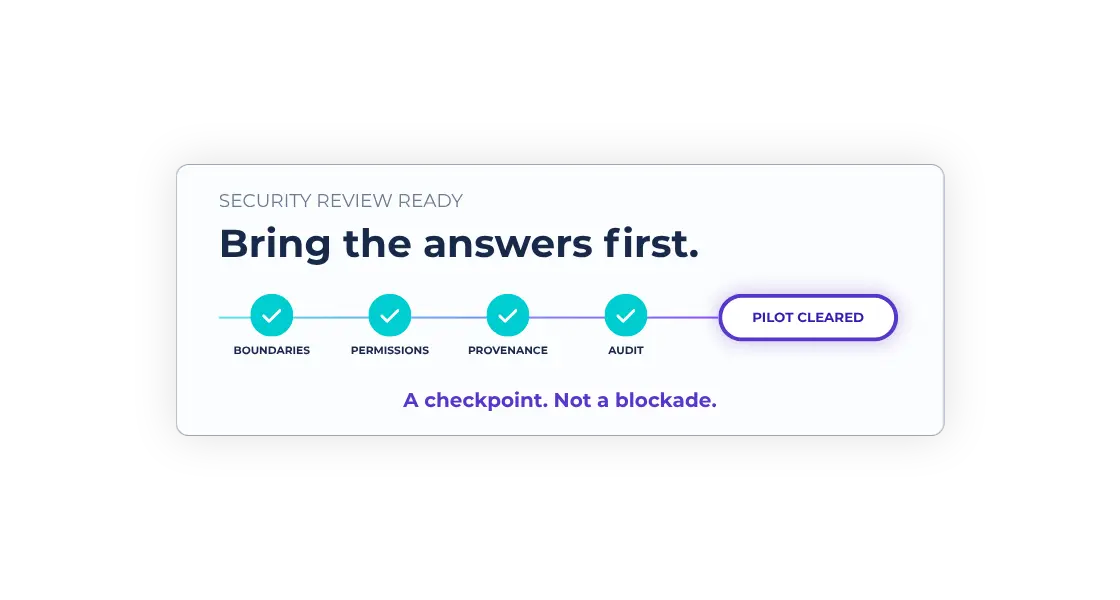
Security review should not begin after an AI pilot has already been sold internally. By then, the sponsor is defending a solution while security and IT are still trying to define the system.
What should an AI security checklist for product development include? It should define the use case and data boundary, map the complete data flow, test identity and authorization, examine model-specific risks, verify evidence provenance and auditability, assess vendor operations, and define integrations, export, and exit.
This is especially important in product development, where the data may include unreleased specifications, customer requirements, test results, research, intellectual property, quality records, cost assumptions, supplier information, and expert know-how.
The fastest security review is not the one with the fewest questions. It is the one that defines the system early enough for the answers to shape the pilot.
Before reviewing the vendor, document:
“AI for engineering” is difficult to approve. “Compare incoming customer specifications with the approved product record for one line, used by six named engineers, with no production write-back” is reviewable.
Ask where data enters, where it is stored, which services process it, where model inference occurs, which logs are created, and how information leaves the system.
Require current vendor documentation for:
These details can change and belong in security, privacy, and contractual materials—not in assumptions inferred from marketing copy.
Review:
Then test with two users who have different access. The critical question is not whether a restricted file is hidden in the interface. It is whether its contents can influence an answer, comparison, generated document, agent output, or external-client response for an unauthorized user.
Traditional SaaS controls do not answer every AI question. Ask:
NIST’s AI Risk Management Framework and Generative AI Profile provide a useful structure: Govern, Map, Measure, and Manage risk in the actual context of use. Explore the NIST AI RMF.
For product-development work, security, quality, and technical governance overlap. Determine whether the system preserves:
A citation is not a complete audit trail. A sound review connects the evidence used, output produced, people involved, and decision that followed.
Request current evidence for the controls that matter to the organization, including:
Narratize-specific certification, hosting, encryption, retention, model-training, and subprocessor claims should be taken from the current security packet and contract during review. This article does not substitute for those materials.
For every connection, document:
Narratize supports point-in-time source selection from OneDrive, SharePoint, and Google Drive; ingestion from Jira, Confluence, and Aha!; direct uploads and URLs; and authenticated MCP access to hub retrieval and selected agents. These are live patterns, but point-in-time cloud files do not refresh automatically when the source changes.
The Integration Layer is expanding through Power Automate and deeper connector orchestration. Direct PLM, ERP, LIMS, and other specialized connections, two-way synchronization, and no-code integration building are broader roadmap layers. Security review should assess the connection actually proposed and the delivery state on which the contract depends.
Expiration and approval alerts support current governance. Narratize is expanding high-priority workflow, stage-gate, compliance, integration-failure, and live regulatory alerts, along with in-app and email delivery options.
Portfolio Intelligence is in build to provide cross-hub health, stage progression, evaluation summaries, Knowledge Readiness scoring, reliability signatures, and natural-language portfolio questions. As those views come online, security teams should test whether every aggregate, chart, export, and drill-down respects the underlying hub permissions.
Exit is part of architecture, not an end-of-contract administrative detail.
Narratize supports organization and hub administration, granular member permissions, and SSO including Okta and Google. Product Knowledge Hubs separate product- and program-specific contexts. Per-hub settings can exclude sensitive hubs from cross-hub queries.
Drafts remain visible to authorized hub members but are not retrieved by AI until saved as knowledge. Source citations, document instructions, version history, lineage, configured approvals, and workflow override records support traceability. The platform’s named Red Team Agent and other purpose-built evaluations remain grounded in permitted hub knowledge and their approved external-source behavior.
The decision-grade AI procurement checklist provides six benchmark tests for source support, missing evidence, conflicts, superseded documents, permissions, and change.
That packet gives security, IT, legal, quality, product, and the business a shared definition of what has actually been approved.
Bring the security questionnaire and proposed pilot boundary. Narratize can map current controls, required evidence, open questions, connector architecture, and delivery dependencies before implementation begins. Request a security and architecture review.
Schedule a demo and watch your team's expertise become intelligence the whole organization can use.