
Blog
Connect every consequential product requirement to customer evidence, technical constraints, assumptions, owners, and validation.
Most teams describe the product requirements document as a writing deliverable. In practice, the hard part happens before the writing: finding current customer evidence, reconciling competing inputs, recovering technical constraints, locating prior decisions, and deciding which assumptions are strong enough to become requirements.
What is PRD traceability? PRD traceability is the ability to connect every consequential product requirement to its rationale, supporting customer and technical evidence, assumptions, owner, dependencies, validation method, approval, and change history.
Generic AI can make the prose arrive faster. A polished PRD built on incomplete or untraceable evidence simply makes uncertainty look finished.
A decision-grade product requirements document should not only say what the product must do. It should show why the requirement exists, what supports it, who owns it, and how the team will know it has been met.
Begin with five evidence layers before drafting sections:
A PRD that omits one of these layers may still look complete. The omission tends to surface later as rework: a requirement engineering cannot verify, a claim compliance cannot support, or a concept manufacturing cannot produce at the target economics. The five knowledge domains provide a broader model for testing that coverage.
For every requirement that materially affects customer value, architecture, cost, safety, claims, compliance, manufacturing, or schedule, capture:
This structure is usually lighter than the review cycles required to reconstruct the same information after questions begin.
Many PRDs blur three different statements:
Each may be reasonable. They are not equivalent facts. Labeling the chain makes review faster because the team can challenge the correct link. Market research can test the assumption; engineering can test the specification; product leadership can decide whether the trade-off is worth the cost.
A testable product requirement identifies the subject, required behavior or performance, operating conditions, threshold, and verification method. It avoids words such as “fast,” “intuitive,” “robust,” or “easy” unless the team defines how those qualities will be measured.
For consequential requirements, ask:
Not every early requirement will have a final value. A preliminary range can be valid when its status, owner, evidence plan, and decision deadline are explicit.
A traditional review proceeds section by section. A stronger review asks cross-cutting evidence questions:
The output should be a clearer decision state, not merely a document marked approved. The cross-functional alignment framework shows how to distinguish source, meaning, time, and decision drift during that review.
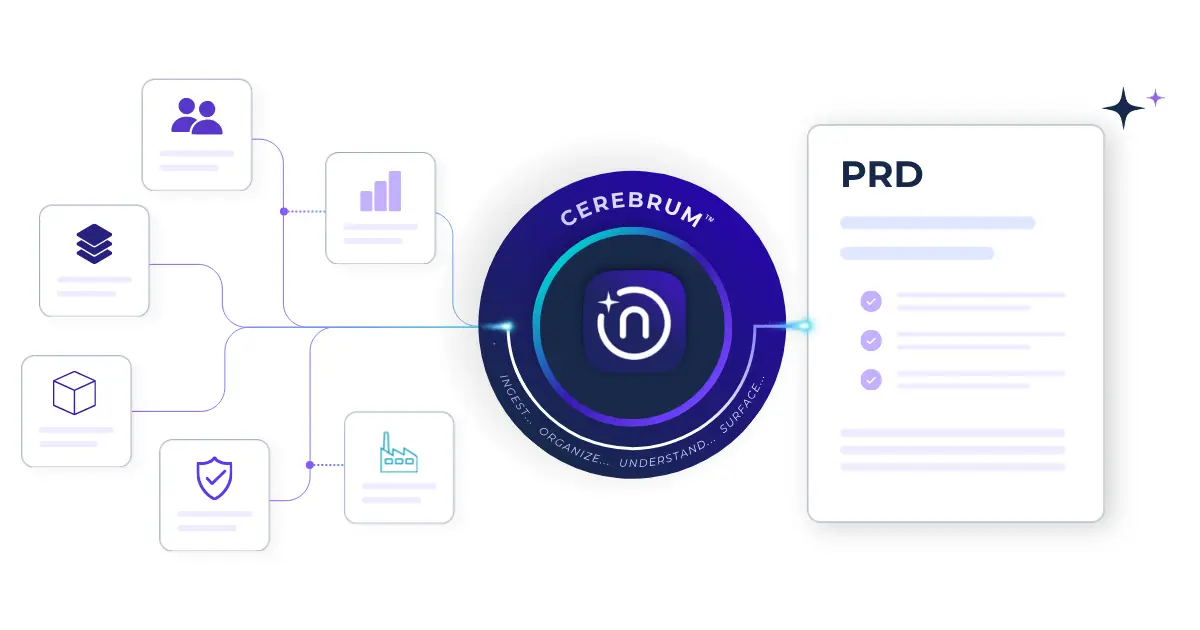
Teams can bring customer research, market analysis, technical documents, standards, test results, meeting records, spreadsheets, presentations, and expert input into a Product Knowledge Hub. The live Product Requirements Document template guides contributors through structured questions and can use selected documents or broader hub knowledge to draft the document.
Template auto-fill extracts candidate answers from selected evidence for review before generation. The resulting document opens in the editor, where users can revise it, apply audience and style changes, preserve versions, compare changes, and save the approved result as governed hub knowledge. Source-linked chat, Alignment Checker, and document lineage help reviewers inspect the evidence behind key statements.
An industrial equipment manufacturer shows where this approach can begin: using existing product knowledge to generate requirements summaries alongside epic charters, test plans, and launch briefs in minutes. For a product manager building a PRD, that is a useful way to get relevant context into a reviewable first draft. The next job is to examine each consequential requirement with engineering and the other accountable functions: what supports it, what remains assumed, and how it will be verified. See the industrial equipment manufacturer’s documentation workflow.
Customer-specific templates can be configured from the organization’s current PRD. Organization-level workflows can place the PRD at the correct lifecycle stage, define its required inputs and approvals, and show when it is ready to generate. Narratize is expanding broader self-service workflow and agent administration so hub and group administrators can control more of that operating model directly.
The self-serve Custom Template Builder is a separate later roadmap capability; it should not be confused with workflow configuration or with the custom templates Narratize already implements from customer examples.
When the evidence set lacks design rationale, application knowledge, prior failure context, or a manufacturing boundary, teams can send a targeted expert question, use an interview template, or ingest a recorded interview today. Guided asynchronous expert interviews are in build to add contextual follow-up questions, completion dates, an expert-facing flow, and a distinct governed knowledge object.
This matters because the best requirement often depends on expertise that never appeared in the formal source set. Capturing it with scope, ownership, and decision context makes it reviewable without pretending expert judgment is the same as validated data.
The live Market Intelligence, Research, IP Landscape, and Compliance Verification agents can add current external evidence and identify documentation implications. Narratize is extending this into live regulatory alerts that route relevant changes to the affected product context and owner.
Current enterprise-source options include point-in-time OneDrive, SharePoint, and Google Drive files, Jira, Confluence, and Aha! ingestion, and MCP access. Broader direct PLM, ERP, LIMS, and two-way connectors are part of the expanding Integration Layer. Each implementation should define which system remains authoritative and what change requires the PRD to be reviewed.
Choose the ten requirements most likely to affect architecture, cost, safety, claims, or schedule. For each, ask:
Score one point for every “yes.” A requirement scoring two out of five is not necessarily wrong. It is visibly immature—which is exactly what the PRD should make clear before the organization treats it as a commitment.
Early product development contains uncertainty by definition. The goal is not to wait until every question is closed. It is to make uncertainty explicit, traceable, and owned so decision-makers can judge whether the current evidence is sufficient for the next investment.
Bring a current PRD and the source material used to create it. Narratize can show which requirements are traceable, which assumptions are hidden, and what a hub-grounded drafting workflow would change. Schedule a PRD evidence review.
Schedule a demo and watch your team's expertise become intelligence the whole organization can use.