
Blog
Align engineering, quality, regulatory, and commercial teams around one current body of evidence, decision history, ownership, and change.
When engineering, quality, regulatory, product, and commercial teams disagree about a product, leaders often prescribe more collaboration: another steering committee, another shared channel, another weekly sync. Sometimes that helps. Often it does not, because each function is operating from a different version of the evidence.
What causes cross-functional misalignment in product development? Most misalignment comes from source drift, meaning drift, time drift, or decision drift: teams are using different evidence, interpreting the same terms differently, relying on conclusions that have become stale, or acting on a decision without its rationale and implications.
Everyone can be acting responsibly from the information in front of them—and the organization can still be wrong as a whole.
Cross-functional alignment is not the absence of disagreement. It is the ability to see the same evidence, understand what changed, and resolve disagreement before it reaches a gate, an auditor, or a customer.
These forms of drift compound. A commercial claim may be linked to a real test report, but not the latest report. A specification may be current, but use a term differently from the quality plan. A gate decision may be recorded, but nobody downstream can see why the committee accepted the remaining risk.
More meetings can temporarily synchronize people. They cannot repair the underlying evidence architecture.
For each consequential product claim or decision, every function should be able to answer five questions:
This is not a demand to centralize every enterprise record in one application. PLM, QMS, ERP, CRM, LIMS, and document systems should continue to do the jobs they were designed to do. The contract defines the decision-critical context that must remain connected across them. That is the role of a product intelligence layer.
“Create a single source of truth for the product” is too broad to implement or measure. A more useful starting point is one expensive handoff where interpretation changes hands:
Trace one real decision through that handoff. Can the receiving team find the original evidence? Can it distinguish the approved version from a draft? Can it see assumptions and exceptions? Can it tell who approved the interpretation? Can it identify what must be reconsidered if the input changes?
Every “no” is a specific design requirement. That makes the problem tractable and gives the organization a concrete way to measure improvement.
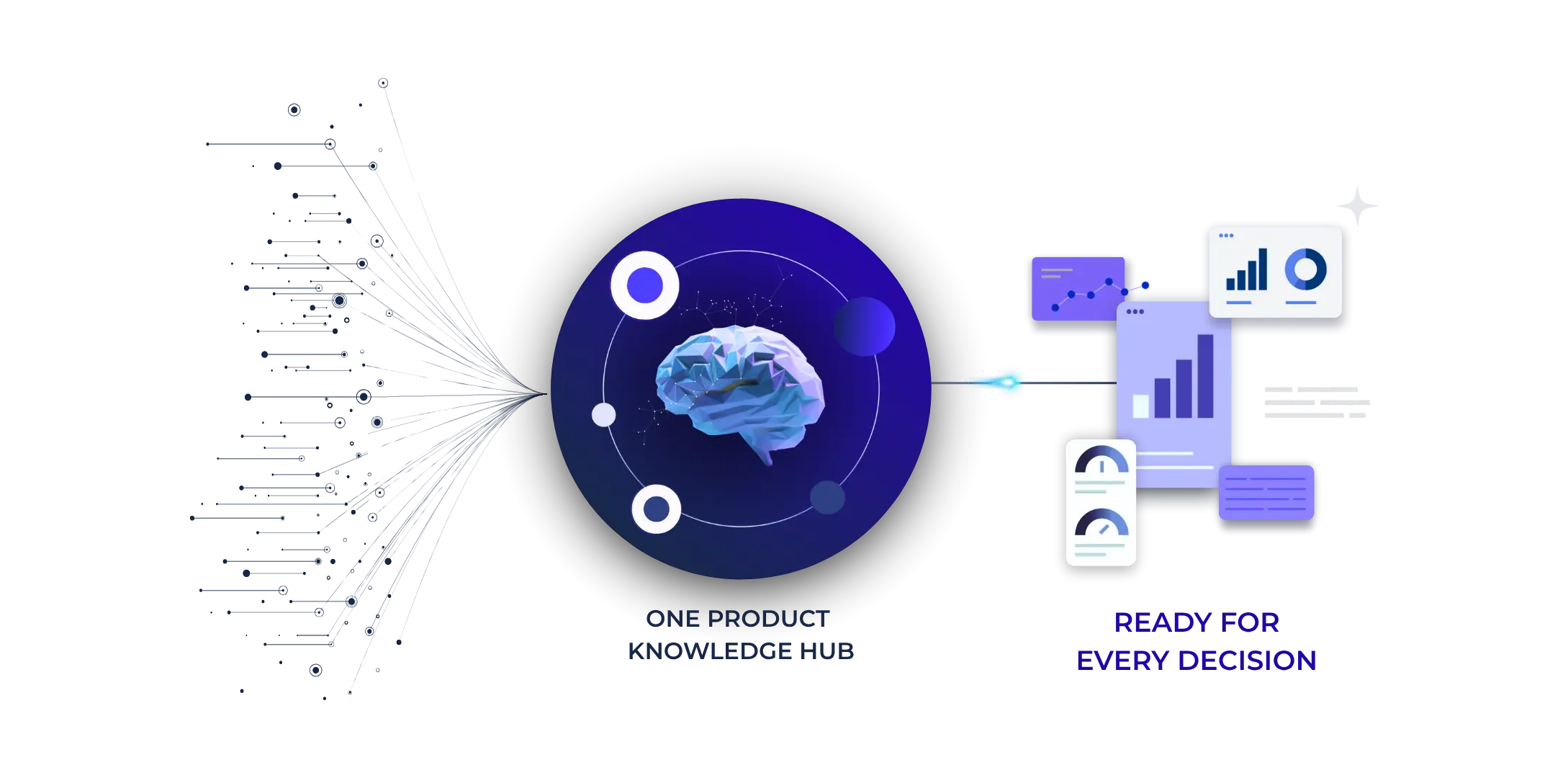
Product Knowledge Hubs give the decision-critical evidence for a product, program, or topic a governed home. Teams can add specifications, test reports, research, customer evidence, presentations, spreadsheets, meeting records, audio, video, and expert input; query that knowledge in natural language; and inspect the sources behind every answer.
Version history, permissions, instructions, workflow stage, approvals, override history, and document lineage help teams distinguish current, approved knowledge from drafts and superseded inputs. Cross-Hub Chat supports questions across permitted programs without removing their boundaries.
The live Alignment Checker verifies whether claims match the available evidence and whether messages, requirements, and product documents remain consistent. It can run hub-wide or inside a document, where reviewers can inspect, accept, or dismiss findings. The named Red Team Agent challenges the assumptions behind a recommendation, while Knowledge Gap assessment identifies what is missing for a deliverable, stage, or framework.
Organization-level workflow templates can encode stages, inputs, outputs, approvals, and exception paths today. Hubs inherit the assigned workflow, and teams can associate evidence directly with the stage where it matters. Narratize is expanding self-service workflow and agent configuration so hub and group administrators can adapt more of that operating model directly.
When misalignment depends on unwritten rationale, teams can send a targeted expert question, structure an interview, or ingest recorded discussions now. Guided asynchronous expert interviews are being added to ask contextual follow-up questions, track completion, and preserve the contribution as governed knowledge linked to the decision it informs.
Narratize can ingest point-in-time content from OneDrive, SharePoint, Google Drive, Jira, Confluence, and Aha!, alongside direct uploads and URLs. Its live MCP server also makes hub retrieval and selected agents available to authenticated external clients.
The Integration Layer is expanding through Power Automate and deeper enterprise connectors. Direct PLM, ERP, LIMS, and two-way synchronization are part of the broader roadmap. Each implementation should specify which system remains authoritative, what moves into the hub, and how currentness is maintained rather than relying on a vague promise of universal sync.
A personal care CPG manufacturer used Product Knowledge Hubs and repeatable document templates to create more consistent documentation, reduce review loops, and reuse prior rationale and methods. For teams carrying scientific work into product-development documents, that makes the handoff concrete: colleagues can work from a shared body of knowledge and a familiar document structure. The customer story describes qualitative improvements in consistency and reuse, giving readers a practical example of how shared context can reduce the need to reconstruct the same explanation during each review. Read the personal care manufacturer case study.
If the exercise produces three different “current” answers, the organization does not have a meeting problem. It has identified the first evidence-architecture problem to solve.
Bring one contested handoff to a Narratize discovery call. The team will map the sources, decision history, owners, and review points required to make it answerable. Schedule a discovery call.
Schedule a demo and watch your team's expertise become intelligence the whole organization can use.