
Blog
Use five knowledge domains to expose what a product decision knows, assumes, contradicts, and still needs before the next investment.

A product-development team can complete every required document and still be unready to invest. The customer need may be weakly evidenced. The technical result may apply to a different configuration. The cost target may conflict with the architecture. The expert who understands the prior failure may not be in the review. The rationale behind a pivotal choice may never have been recorded.
What are the five knowledge domains behind better new product development decisions? They are people and expertise; product and technical knowledge; market and customer knowledge; business and strategic knowledge; and process and decision context. A decision is strongest when the relevant evidence is sufficient within each domain and aligned across them.
These are not merely document categories. They are distinct kinds of knowledge that must be reconciled before a team can make a defensible commitment.
The unit of readiness is not the finished artifact. It is the decision and the sufficiency of the knowledge supporting it.
PDMA’s 2021 global best-practices research, based on 651 companies in 37 countries, found that no single capability was necessary or sufficient for superior performance; leading firms combined multiple practices skillfully. The practical value of a domain model is that it makes the combination visible. Read the PDMA study.
The model helps teams diagnose four different failure modes:
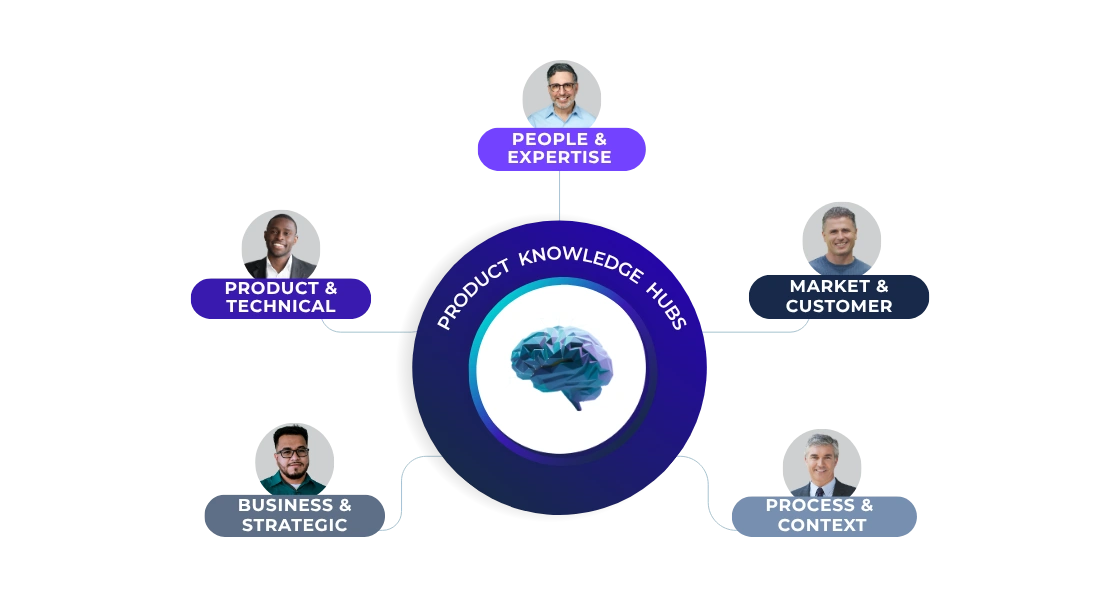
This domain covers who knows what, how that knowledge was acquired, where its limits are, and who has authority to interpret or approve it.
It includes:
Failure signal: the team has the documents but still says, “We need the person who was there to explain what this means.”
Decision question: Do we have the right expertise in the room, and have we preserved the judgment the decision depends on?
This is the current and historical understanding of the product, technology, formulation, architecture, process, and performance.
It includes requirements, specifications, models, test data, design alternatives, manufacturing constraints, failure modes, prior experiments, supplier information, and the conditions under which each conclusion applies.
Failure signal: a technically correct result is reused for the wrong configuration, environment, scale, or intended use.
Decision question: What is technically known, for which product state, under which conditions, and with what confidence?
This domain covers the people, applications, jobs, constraints, alternatives, competitive context, channels, and external conditions that give the product a reason to exist.
It includes verbatim customer evidence, observed behavior, unmet needs, willingness to change or pay, segment differences, competitor claims, standards, patents, regulatory developments, market dynamics, and supply-chain signals.
Failure signal: the product meets the written requirement but not the use condition or purchase decision that created it.
Decision question: Whose problem are we solving, what evidence shows it matters, and what external change could invalidate our view?
This domain connects the program to the company’s choices: where to compete, how to win, what economics are acceptable, and which risks the organization is willing to take.
It includes strategic fit, portfolio role, investment thesis, revenue and margin logic, cost and capital assumptions, capacity, timing, channel implications, cannibalization, and alternative uses of resources.
BCG’s 2024 innovation research found that 83% of surveyed companies ranked innovation among their top three priorities, but only 3% scored in its “ready zone”; just 12% reported a strong link between business and innovation strategy. Organizations with strong alignment reported a share of sales from new products five percentage points above the sample average. Review BCG’s findings.
Failure signal: the team can defend the product but cannot explain why this is the best use of the next dollar or month.
Decision question: Why this opportunity, why this approach, why now, and compared with what alternative?
This domain explains where the work is in the lifecycle, what decision is being made, which criteria apply, what changed, and why previous choices were accepted.
It includes workflow stage, required inputs and outputs, assumptions, trade-offs, exceptions, approvals, dissent, dependencies, decision rationale, and review triggers.
Failure signal: the organization knows what was decided but must reconstruct why—and therefore relitigates the same choice.
Decision question: What are we deciding at this stage, what changed since the last decision, and what would cause us to revisit it?
Usually at the intersections among domains:
Assessing domains separately is only the first step. The team must also test whether the conclusions align.
Choose one live decision—not the entire program—and assess each relevant domain on six dimensions:
Do not average the scores into a reassuring percentage. A single missing feasibility condition or invalid market assumption can outweigh broad coverage elsewhere. Identify blockers, accepted uncertainty, and the next evidence required.
Product Knowledge Hubs give documents, data, external research, expert input, workflow context, generated work, and decision history a governed home. Source-linked chat and generation let teams interrogate the evidence. Cross-Hub Chat supports questions across permitted product and program contexts.
Purpose-built agents examine different parts of the model:
Organization-level workflows already connect knowledge to lifecycle stages, required inputs and outputs, approvals, and exceptions. Narratize is expanding broader self-service workflow and agent configuration so hub and group administrators can manage more of that operating model directly.
A global tire manufacturer brought historical research, test results, and decision rationale into Product Knowledge Hubs to support literature synthesis and hypothesis development. Its nine-person pilot covered four Rapid Learning Cycles. For scientists and engineers choosing the next experiment, the relevant pattern is bringing prior findings and their reasoning into the decision together, so the next investigation starts with more of what the organization already knows. Read the global tire manufacturer case study.
Teams can capture targeted expert answers inside a Write workflow, use interview templates, and ingest transcribed audio or video today. Guided asynchronous expert interviews are in build to add categorized question banks, scheduling, contextual follow-ups, an expert-facing flow, and a distinct governed knowledge type.
Portfolio Intelligence is in build as an executive layer above the hubs. Its Knowledge Readiness model is designed to assess Coverage, Confidence, Currentness, and Connections by program; combine that view with stage progression and agent findings; and let leaders drill from a portfolio signal to its supporting evidence.
The platform does not automatically decide that every domain is sufficient. Domain importance and evidence thresholds depend on the decision, lifecycle stage, methodology, and risk. The accountable team defines those conditions and owns the conclusion.
Select a requirement, claim, architecture choice, material decision, customer commitment, or gate recommendation that has been reopened more than once. Map the five domains behind it. The missing evidence and unresolved contradictions will show why the decision has remained unstable.
Bring one recurring product decision and the evidence currently used to make it. Narratize can facilitate a five-domain sufficiency review and identify the smallest knowledge system needed to make the next decision durable. Schedule a knowledge-domain workshop.
Schedule a demo and watch your team's expertise become intelligence the whole organization can use.