
Blog
Run stage-gate around decision criteria, current evidence, assumptions, approvals, exceptions, and decision records—not file completion.

Most stage-gate systems are good at showing whether an artifact exists. They are much less reliable at showing whether the artifact is current, supported, approved, and sufficient for the next investment.
What is an evidence-based stage-gate process? It is a stage-gate process that tests whether decision-critical evidence is current, applicable, reviewed, and sufficient—not merely whether required files have been uploaded or marked complete.
That distinction matters in advanced manufacturing. A completed feasibility study may rely on an obsolete configuration. A finished business case may rest on an untested market assumption. A green status cell may conceal a known exception that only one person understands.
A gate is not a document deadline. It is a decision about whether the organization knows enough—and has reduced the right risks—to make the next commitment.
For each required input or output, distinguish five states:
A preliminary technical study may be decision-sufficient at scoping and inadequate at validation. Stage context changes the standard; file status does not.
The product development documentation guide outlines the requirements, design records, test evidence, and handoffs that can support a gate decision. Adapt the document set to the decision and stage.
For each gate, define:
This prevents the workflow from becoming a universal document checklist. The purpose of a required deliverable is to inform a criterion; the purpose of the criterion is to support a decision.
Associate each consequential document, dataset, expert contribution, and external source with the stage and decision it informs. Then ask:
This is where a Product Knowledge Hub differs from a status board. A reviewer can move from the gate recommendation to the underlying evidence and decision history without reconstructing the chain in the meeting.
An industrial equipment manufacturer used Narratize to generate epic charters, requirements summaries, test plans, and launch briefs in minutes from its product knowledge. For an NPI team preparing a gate, these materials connect the proposal to its requirements, planned validation, and launch decisions. Faster preparation creates more room for reviewers to examine the evidence and resolve open questions; the gate decision still belongs to the accountable team. Read the industrial equipment manufacturer case study.
Real programs advance with incomplete work. A useful stage-gate process should support that reality without turning uncertainty invisible.
For every exception, record:
“Advance with conditions” is a legitimate governance state. It should not be represented by changing an incomplete cell to green.
Run structured readiness and adversarial reviews while the team still has time to respond. Evaluate:
Narratize’s named Red Team Agent can pressure-test the recommendation in Constructive Review, Adversarial Challenge, or Pre-Mortem mode. The StageGate Decision and Readiness Agent can evaluate the available evidence against the configured gate standard, while Alignment Checker surfaces conflicting claims across the hub.
A challenge list alone is not readiness. Give each material finding a disposition: resolve, gather evidence, revise, escalate, accept and monitor, or stop.
At the gate, record the decision, rationale, conditions, dissent, accepted risks, approvals, and follow-up evidence. Link that record to the recommendation and source set reviewed at the time.
At the next gate, begin with what changed. This prevents every review from becoming a fresh retelling of the program and gives future teams the reasoning behind its trajectory.
Narratize supports reusable organization-level workflows with configurable stages, inputs, outputs, status, and version control. Product Knowledge Hubs inherit the assigned workflow. Teams can associate documents with stage inputs, see what is present or missing, identify which outputs are ready to generate, and advance with incomplete requirements when governance permits it. Missing work remains visible and the override is logged.
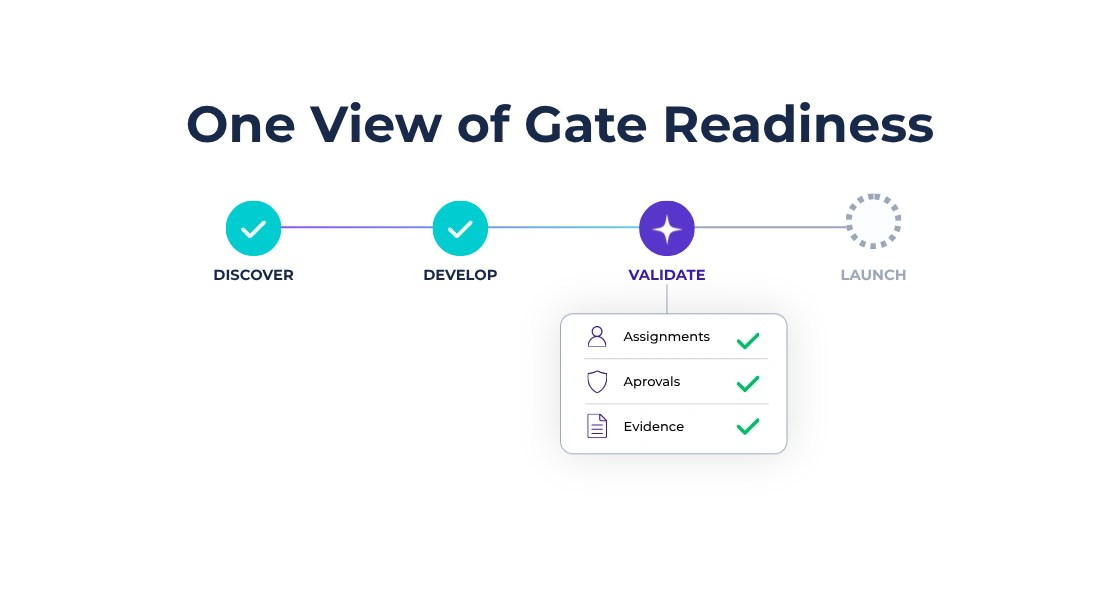
Stage-gate, agile, and hybrid methods can be configured around the organization’s terminology and decision logic. Broader self-service administration for workflow and agent configuration is being expanded so hub and group administrators can manage more of that operating model directly.
Targeted expert questions and structured interview templates are available now when rationale is missing. Narratize is extending this into guided asynchronous expert interviews that schedule the request, ask contextual follow-up questions, and preserve the resulting expertise as a governed knowledge type.
Gate Deck templates, source-linked generation, approvals, versions, and document lineage support the review record today. Native PowerPoint generation is in build, enabling teams to turn the governed evidence pack into an editable presentation without recreating the story slide by slide. Workflow alerts beyond the current approval and expiration alerts are also being expanded.
For leaders managing multiple programs, Narratize’s Portfolio Intelligence layer is in build. It will add cross-hub health views, stage progression, knowledge-readiness scoring, evaluation summaries, and natural-language portfolio questions while preserving drill-down to the evidence behind each signal.
Narratize complements PPM, PLM, ERP, QMS, LIMS, and document systems. Its role is to connect the evidence, expertise, workflow context, and rationale those systems do not hold together on their own.
Useful measures include:
The goal is not simply a faster gate. It is a gate that makes uncertainty inspectable and investment logic reproducible. The stage-gate review checklist translates this operating model into the evidence pack decision-makers should receive.
Bring one current gate definition, its required deliverables, and the last review pack. Narratize can map where completion is being mistaken for evidence sufficiency. Schedule a stage-gate evidence workshop.
Schedule a demo and watch your team's expertise become intelligence the whole organization can use.