
Blog
Use Narratize’s named Red Team Agent to challenge assumptions, expose evidence gaps, and run a structured pre-mortem before investment.

Most product plans are reviewed by people who helped create them. Teams become fluent in the same evidence, normalize the same assumptions, and gradually stop noticing the questions an outsider would ask.
What is a product pre-mortem? A product pre-mortem assumes that a future initiative failed, then works backward to identify plausible causes, missed signals, unsupported assumptions, and actions that could reduce the risk before the decision becomes expensive.
What is Narratize’s Red Team Agent? It is a named, purpose-built agent that pressure-tests a product decision against the knowledge in a Product Knowledge Hub. It supports Constructive Review, Adversarial Challenge, and Pre-Mortem modes and returns source-traceable findings for human disposition.
A useful red team does not produce the longest list of worries. It finds the assumptions and evidence gaps most capable of changing the decision.
Use it before a consequential commitment, especially when the team is about to:
Run the review early enough for the team to gather evidence or change the plan—not as a ceremonial critique after the recommendation is already locked.
“Review the business case” is too vague. Name the actual decision and consequence:
Then state what must be true for the decision to be sound. These are the decision conditions: the customer need is real, the technical approach is feasible, the economics are credible, the evidence meets the required standard, the supply chain can support the choice, and the organization can execute.
The Red Team Agent should test those conditions—not merely comment on the prose.
Define what the agent may treat as evidence. Include the current business case or plan, customer research, technical studies, cost assumptions, risk records, prior-program lessons, market evidence, regulatory context, and relevant expert input. Exclude superseded material unless the purpose is to compare change over time.
Also record what is missing. An agent cannot recover a supplier quote that was never added or a rationale that was never captured. Missing evidence is a finding; it should not be replaced by plausible language.
The first test of decision-grade AI is whether it distinguishes “the evidence says” from “the evidence set does not contain enough to say.”
Identifies what would make the plan clearer, better supported, more internally consistent, or easier to approve. Use it while the work is still being shaped.
Tests which claims, assumptions, contradictions, and dependencies a skeptical technical, commercial, quality, regulatory, or executive reviewer would attack. Use it before a gate, customer commitment, or major investment.
Assumes the program failed in the future and develops plausible causal chains: what happened first, which signal was missed, which assumption proved wrong, and which current evidence should have warned the team.
The modes should produce different outputs. If all three return the same generic risk list, the decision question or evidence set is too broad.
This prevents a speculative concern from receiving the same attention as a documented contradiction.
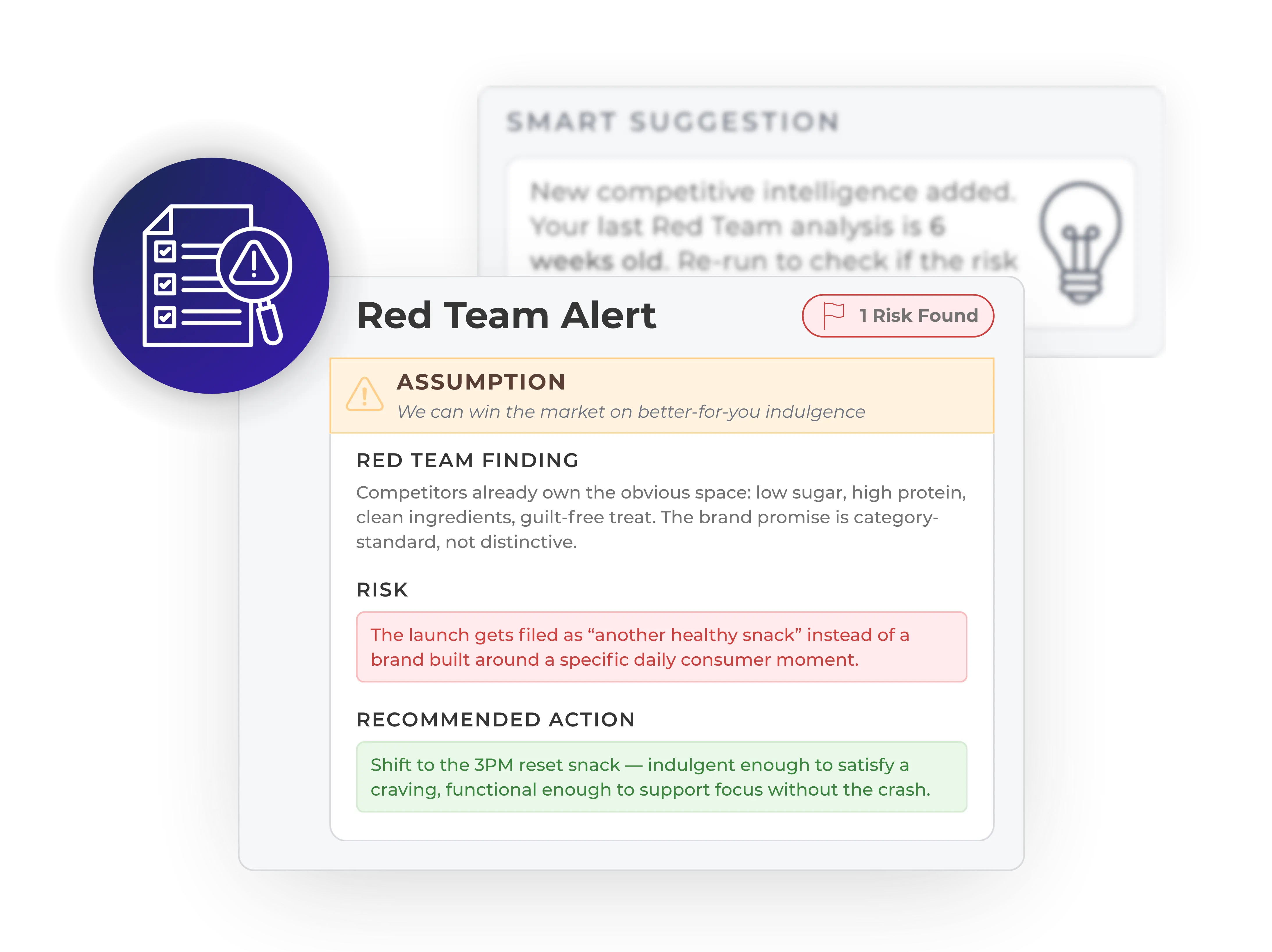
Add a named owner, due date, and decision threshold. “Research further” is not a disposition unless the team knows what result would change the recommendation.
The most valuable output is not the critique. It is the record of how the team responded.
Save the challenge, source links, dispositions, and final decision together so future teams can see:
That record becomes useful at the next gate, in a post-mortem, and when a future program encounters the same trade-off. Red teaming compounds into organizational intelligence only when the response is preserved.
The Red Team Agent runs against the governed hub knowledge selected for the review. It pressure-tests technical feasibility, market assumptions, competitive positioning, business-case logic, execution, adoption, regulatory considerations, supply chain, and intellectual-property assumptions. Findings remain connected to the available evidence.
The agent works alongside other purpose-built evaluations:
Workflow configuration can place the red-team review before a gate, approval, customer commitment, or launch. Broader self-service workflow and agent administration is being expanded so hub and group leaders can control more of those evaluation paths directly.
It does not know facts absent from the hub, determine the organization’s risk appetite, replace technical or legal review, or make the investment decision. A source-linked challenge can improve judgment; it does not remove the accountable reviewer.
When critical rationale exists only in expert memory, teams can capture a targeted answer or use an interview template today. Guided asynchronous expert interviews are being added to ask contextual follow-ups and preserve the resulting expertise with the decision record.
Do not judge a red team by the number of objections it generates. Better measures include:
The goal is not a harsher review. It is a decision that can explain what the organization knew, what it did not know, and why proceeding was justified.
Use this protocol on one live gate recommendation or business case. Bring the decision conditions and current evidence set; Narratize will show how the Red Team Agent turns them into a reviewable decision record. Schedule a Red Team review.
Schedule a demo and watch your team's expertise become intelligence the whole organization can use.