
Blog
Fives replaced days of spreadsheet comparison with governed product knowledge and source-linked exception review, reducing review time 80%.

Industrial bids are often won or lost before anyone writes the proposal. The critical work is specification review: finding every requirement the standard product meets, every exception engineering must assess, every revision that changes scope, and every clause that could become an unpriced commitment.
How did Fives reduce RFP specification review time by 80%? Fives Intralogistics organized trusted product information in Narratize Product Knowledge Hubs and used the Alignment Checker to compare incoming customer specifications against that evidence. Reviewers moved from exhaustive spreadsheet comparison to source-linked exception review, reducing work that took days to a few hours.
The lesson is not simply that AI can read a long document. High-value automation begins with a defined comparison, a trusted product baseline, source traceability, and a clear boundary between machine review and engineering judgment.
Good automation removes search and comparison work from experts. It does not remove experts from consequential decisions.
A customer package may contain hundreds of requirements distributed across multiple files and revisions. The reviewer is not looking for a summary. The reviewer must determine:
That is a reconciliation problem. Generic summarization can make the package shorter and still miss the business-critical work.
The manual process also creates a capacity problem. The people best qualified to catch a subtle mismatch are usually experienced engineers—the same people needed for design, problem-solving, and customer decisions. Every hour of document hunting consumes scarce judgment before judgment is required.
Fives used three principles: establish the baseline, automate the first pass, and preserve accountable review.
Automation is only as reliable as the record it compares against. The team needs an agreed set of current product specifications, approved documents, known constraints, and relevant prior responses. Source and version visibility matter because “we have the file” is not the same as “this is the baseline engineering trusts.”
A Product Knowledge Hub creates that governed context without requiring every enterprise system to be replaced. Product records can remain authoritative in their systems of record while the evidence needed for the review is assembled around the bid decision.
Narratize’s Alignment Checker compares the incoming package with the selected hub knowledge and surfaces conflicts, gaps, inconsistencies, and areas requiring review. Each finding remains connected to the relevant source material.
Reviewers begin with a structured exception set rather than a blank spreadsheet and hundreds of pages. The system performs the exhaustive first pass; people concentrate on the items that require interpretation.
Narratize does not decide whether an exception is acceptable, negotiable, technically feasible, compliant, or commercially sensible. Engineering and cross-functional owners make those calls. The platform makes the evidence easier to inspect and the disposition easier to preserve.
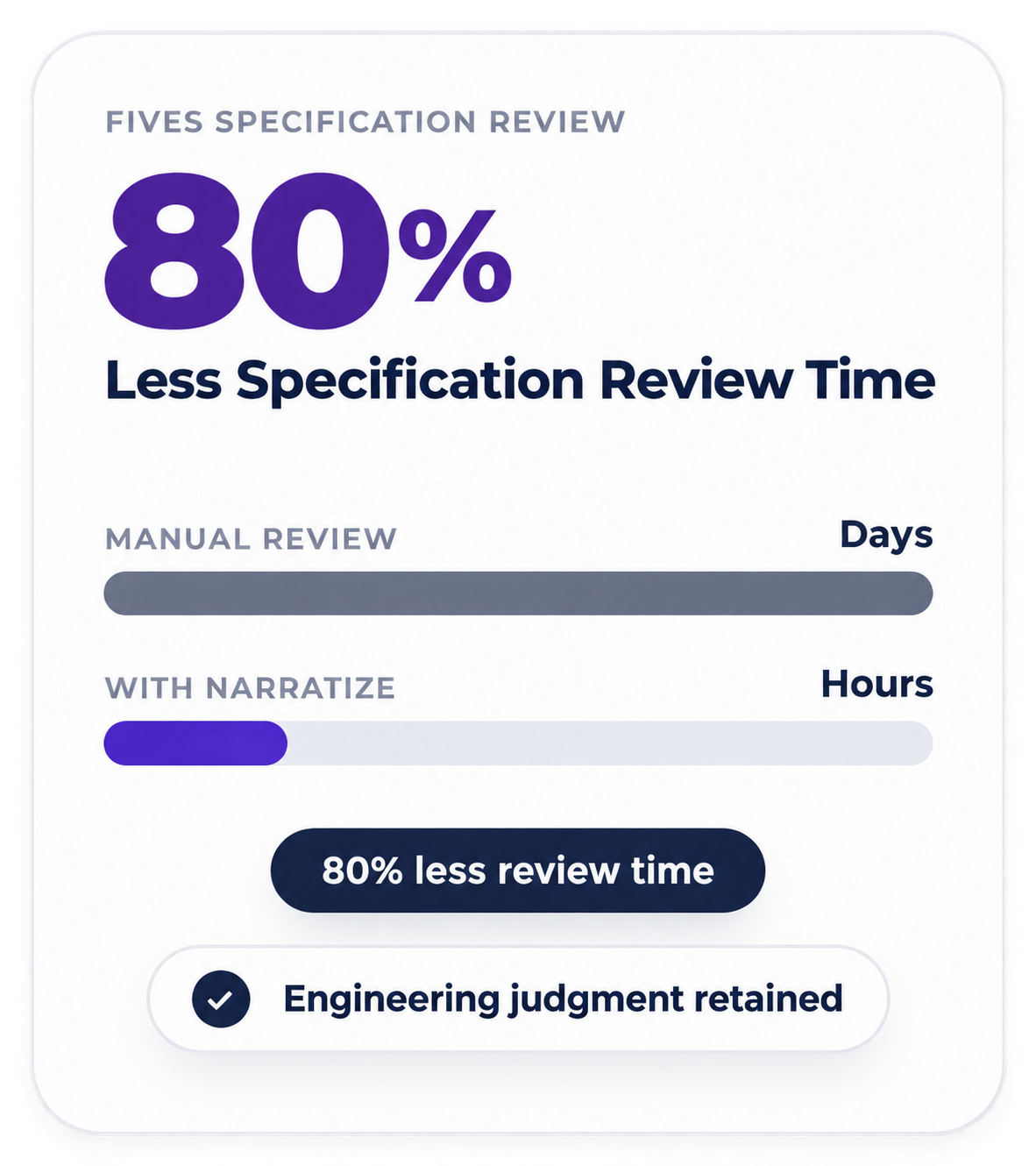
Fives reported an 80% reduction in the time required for customer specification review—from a process measured in days to one measured in hours. Read the full Fives customer story.
This is a credible proof point because it is attached to a bounded workflow:
It should not be generalized into “innovation is 80% faster.” It establishes a more useful standard: measure AI in the units of a real workflow the business already understands.
A rigorous RFP-review business case should separate four value categories:
Recovered time is not automatically hard-dollar savings. Capacity becomes financial value when it increases throughput, avoids outside spend, reduces overtime, defers hiring, or improves another documented constraint. The AI business case for product development connects these benefits to practical customer examples.
The benchmark set gives reviewers known answers against which to assess quality before a live customer commitment depends on the output. The 90-day AI pilot framework provides the broader governance, adoption, and decision criteria.
As the Integration Layer expands, deeper enterprise connectors can reduce source-transfer work. Native PowerPoint generation can also turn approved findings and dispositions into an editable customer or review presentation when that is part of the workflow.
An impressive summary is not enough. The system must help an accountable engineer make a faster, better-evidenced decision.
Bring a recent specification package and the product documents used to review it. Narratize will show the comparison workflow on the work the team actually does. Schedule a specification-review session.
Schedule a demo and watch your team's expertise become intelligence the whole organization can use.