
Blog
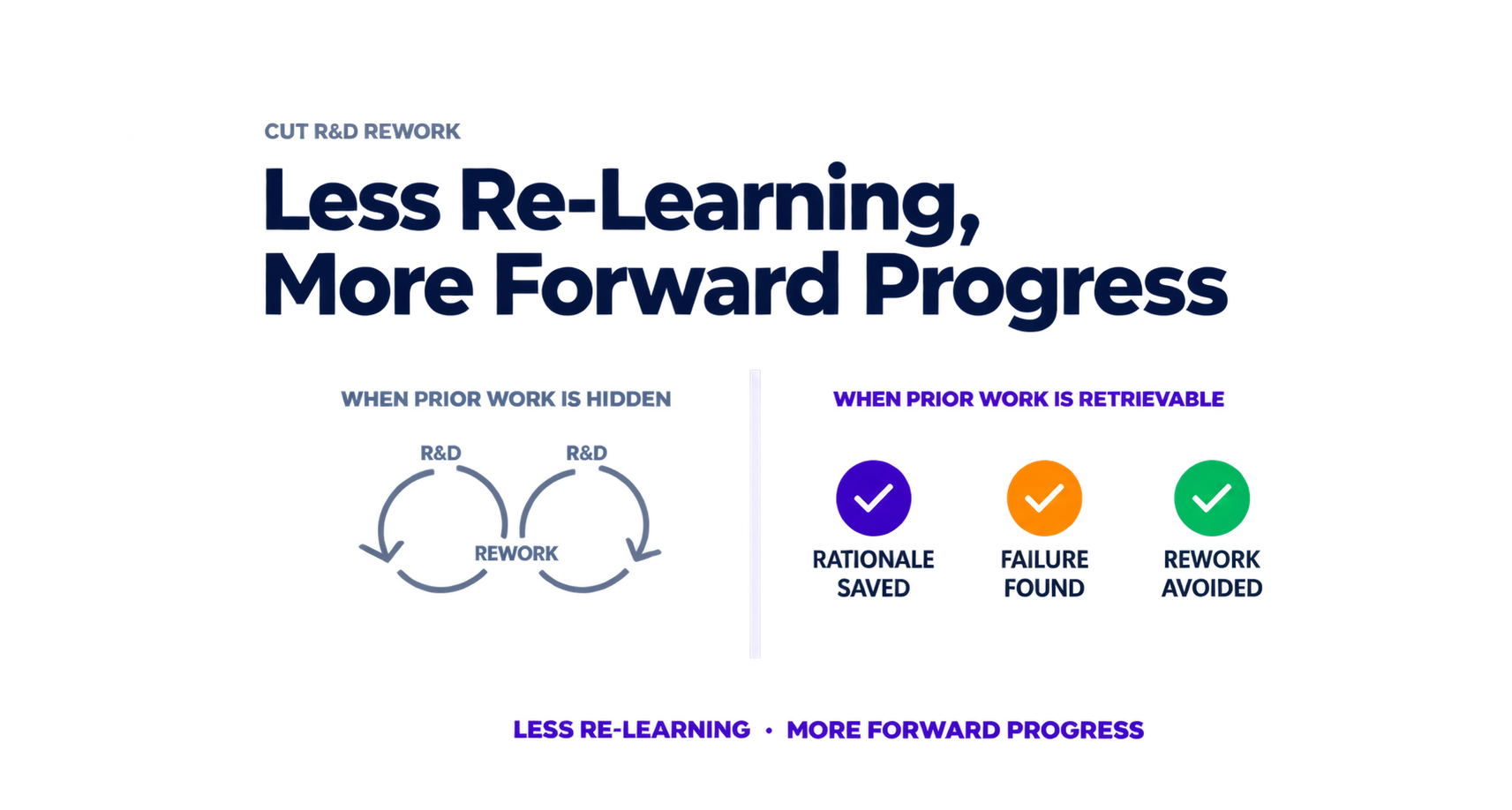
Make design rationale, negative results, expert knowledge, and prior decisions reusable—so future R&D teams do not pay twice to relearn them.

Manufacturers rarely repeat work because nobody ran it before. They repeat it because the prior learning cannot be found, trusted, understood, or applied to the new conditions.
What is R&D knowledge management? R&D knowledge management is the practice of capturing, governing, finding, and reusing technical evidence, expert judgment, negative results, decision rationale, and applicability conditions across research and product-development programs.
A conventional lessons-learned repository stores documents. A working reuse system lets a future team understand what was tried, what the evidence showed, what the organization decided, why, and under which conditions the conclusion still holds.
The useful unit of organizational memory is not the document. It is the decision episode: what the team was trying to determine, what it knew, what it chose, why, and where that conclusion applies.
Five design mistakes make conventional repositories difficult to reuse:
The problem is not a lack of information. It is a lack of reusable context.
A reusable decision episode contains seven elements:
This structure works for formal design decisions and smaller moments: why a test method changed, why an outlier was accepted, why a customer request was declined, or why a formulation route was stopped.
Do not create a second knowledge-management job for the expert. Capture rationale when the decision is made, when a document is reviewed, when a finding is dispositioned, or when a colleague needs an answer.
A specific question—“Why was coating B rejected for humid environments?”—produces more reusable knowledge than “Please document your expertise.” The smallest valuable record may be a source-linked answer, a note attached to a requirement, a disposition on a Red Team finding, or a short interview tied to a live decision.
Before a captured insight becomes reusable knowledge, give it an owner, source or basis, date, scope, confidence, and status. Distinguish expert judgment from validated test evidence. Record disagreement instead of smoothing it into consensus. Preserve the document version and decision state that existed at the time.
Reuse begins with a new question. Retrieval should combine semantic relevance with product context: lifecycle stage, material or component, failure mode, application, customer requirement, standard, market, and decision type.
The future team should receive more than “a related file exists.” It should be able to ask:
A failed experiment is reusable only when the team can distinguish among:
Preserve the hypothesis, configuration, test conditions, observed result, data quality, alternative explanations, confidence, and conditions under which retesting would be justified.
Without that boundary, “we tried that” becomes organizational folklore. With it, the result becomes a decision asset.
Product Knowledge Hubs provide a governed context for reports, spreadsheets, presentations, specifications, images, test records, meeting notes, research, and expert contributions. Audio and video can be transcribed on upload. AI-generated metadata, organization tags, instructions, source dates, and knowledge state make the evidence easier to govern and retrieve.
Teams can ask source-linked questions within a hub or across permitted hubs, save individual answers as knowledge, preserve authored and generated documents with version history, and reuse structured templates across programs. Alignment Checker surfaces inconsistent conclusions. Knowledge Gap assessment identifies missing evidence. The named Red Team Agent challenges assumptions and prior reasoning.
Targeted knowledge capture is available inside the Write workflow: a contributor can send an expert a specific question and preserve the answer with the work. Interview templates structure deeper conversations. Guided asynchronous expert interviews are in build to add categorized question banks, scheduling, contextual follow-up, expert-facing submission, and a distinct governed knowledge type.
A global tire manufacturer used Product Knowledge Hubs to bring historical research, test results, and decision rationale into its research workflow. Teams could draw on that knowledge for hypothesis development and literature synthesis. In a pilot involving nine people across four Rapid Learning Cycles, the manufacturer reported 85% fewer engineering hours. Those results describe the pilot’s learning work. For scientists and engineers revisiting a material or design question, the relevant pattern is having prior evidence and reasoning available when shaping the next investigation. Read the global tire manufacturer case study.
Current source connections include point-in-time files from OneDrive, SharePoint, and Google Drive, plus Jira, Confluence, and Aha! content, direct uploads, URLs, and live MCP access. These patterns let teams assemble relevant evidence without moving every system of record into a new repository.
Narratize’s Integration Layer is expanding through Power Automate and deeper enterprise connectors. Direct PLM, ERP, LIMS, ELN, and two-way enterprise synchronization are part of the broader roadmap. The architecture should preserve the authoritative system, source identity, revision, and refresh responsibility.
Cross-Hub Chat supports permitted retrieval across programs today. Portfolio Intelligence is in build to add executive health views, cross-hub evaluation summaries, Knowledge Readiness scoring, reliability signatures, and natural-language portfolio questions.
Over time, that layer can help leaders identify where knowledge is concentrated, where multiple programs share a risk or gap, and where prior evidence may be reusable. It should not infer scientific applicability automatically; qualified experts remain responsible for determining whether an old conclusion applies to the new conditions.
Repository size is not a success metric. Track:
The objective is not to prevent every repeated experiment. Replication may be scientifically, commercially, or regulatorily necessary. The objective is to repeat work deliberately, with the prior learning visible.
Choose a decision the organization makes across programs—material selection, test-method choice, supplier exception, claims interpretation, tolerance trade-off, or customer-specification response. Reconstruct the last three instances as decision episodes. Then test whether a new team can find, understand, and apply them without interviewing the original participants.
Bring one repeatedly revisited R&D decision. Narratize can map the evidence, rationale, negative results, and expert contributions required to make it reusable. Schedule an R&D knowledge workshop.
Schedule a demo and watch your team's expertise become intelligence the whole organization can use.