
Blog
Connect a cosmetic reformulation to safety, claims, formulation, manufacturing, packaging, live regulatory alerts, and market evidence.

A cosmetic or personal-care reformulation is rarely “just” a formula change.
What should a cosmetic reformulation review include? It should connect the proposed ingredient, supplier, concentration, process, package, or market change to formula evidence, safety substantiation, performance and stability, manufacturing and quality, claims, and market-specific regulatory requirements.
Replacing a preservative, fragrance, surfactant, colorant, raw-material grade, supplier, or packaging component can affect product behavior far beyond the changed line in the formula. The work becomes slow and risky when those dependencies are rediscovered one function at a time.
The central reformulation question is not “Do we have evidence?” It is “Does the evidence still apply to this formula, claim, use, package, process, and market?”
“Equivalent raw material” is an assumption until the relevant equivalence has been defined. Chemical identity may be comparable while impurity profile, odor, color, processing behavior, preservative efficacy, stability, supplier control, or claim eligibility is not.
Composition, specifications, supplier documentation, impurity and allergen information, concentration limits, compatibility, prior use, function, known interactions, and restrictions.
Toxicological information, exposure assumptions, intended use, user population, adverse-event history, and the records supporting the organization’s safety conclusion.
Under the U.S. Modernization of Cosmetics Regulation Act, the responsible person must ensure and maintain records supporting adequate substantiation of product safety. Applicability and record continuity are operational concerns, not only legal ones. Review FDA’s MoCRA resources.
Bench, accelerated, real-time, compatibility, packaging, microbiological, consumer, and instrumental evidence—plus the exact formula, method, package, and conditions each result covers.
Order of addition, mixing, heat and shear, hold time, equipment, scale-up, yield, controls, release criteria, supplier qualification, and plant or co-manufacturer differences.
On-pack, digital, retailer, professional, comparative, environmental, ingredient, performance, and health-adjacent claims, along with the evidence and reasoning that support each one.
Intended use, product classification, labeling, ingredient restrictions, notification or registration requirements, channels, and jurisdiction-specific review.
In the United States, cosmetic labeling and advertising claims must be truthful and not misleading. Claims that a product treats or prevents disease, or affects the structure or function of the body, can change its regulatory classification. The FTC also expects objective claims to have an appropriate evidentiary basis before dissemination. Review FDA guidance on cosmetic claims and FTC health-products advertising guidance.
This record prevents a common failure: inheriting a claim because the product name stayed the same even though the evidence-bearing configuration changed.
The output is not simply an updated formula. It is a defensible chain from change to evidence to approval.
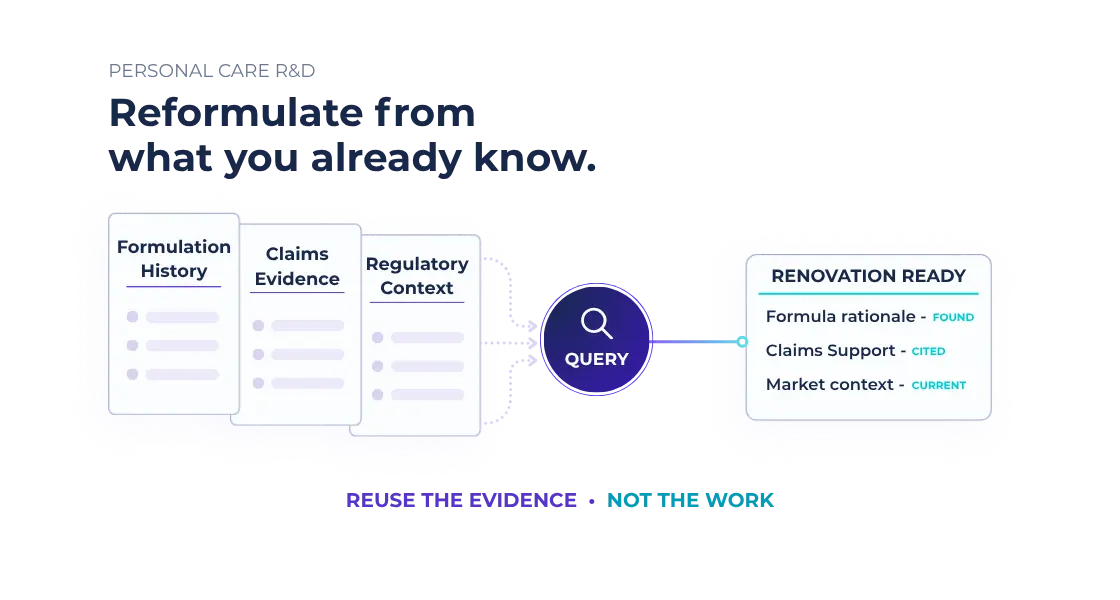
A Product Knowledge Hub can organize formulation history, studies, supplier records, claims, quality work, market research, meeting decisions, and expert input for a product line or reformulation. Teams can ask source-linked questions across that knowledge, generate structured documents from selected evidence, preserve versions and lineage, and route work through configured workflows.
Live agents support different parts of the review:
Scientific communication and clinical-documentation workflows can be configured around a customer’s existing formats. Organization-level workflow templates can define stages, required evidence, outputs, reviews, and exceptions. Narratize is expanding broader self-service workflow and agent administration for hub and group leaders.
A personal care CPG manufacturer used Product Knowledge Hubs and repeatable document templates to make its documentation more consistent, reduce review loops, and reuse prior rationale and methods. For a reformulation team, that is a relevant foundation: earlier reasoning can travel with the work as scientists, product leaders, and reviewers prepare the next set of documents. Scientific applicability, claim substantiation, and regulatory approval still require the relevant evidence and qualified review.
The Market Intelligence Agent can investigate current regulatory developments now. Narratize is extending this foundation into live regulatory alerts designed to connect a material change with affected ingredients, claims, markets, products, workflows, and owners.
The alert should trigger a review—not silently rewrite the formula or declare compliance. Qualified safety, formulation, quality, regulatory, and legal experts remain responsible for interpretation and approval.
Teams can send targeted questions, use interview templates, and ingest transcribed audio or video today. Guided asynchronous expert interviews are in build to ask contextual follow-up questions, manage due dates, and preserve the resulting expertise as a governed knowledge type connected to the reformulation decision.
This is especially valuable for sensory judgment, process adjustments, supplier behavior, prior failure mechanisms, and applicability boundaries that experienced formulators know but formal reports often omit.
Current source connections include point-in-time OneDrive, SharePoint, and Google Drive files; Jira, Confluence, and Aha! ingestion; direct uploads and URLs; and MCP access. Broader direct connections to PLM, ERP, LIMS, formulation, quality, and regulatory systems are part of the expanding Integration Layer.
Native PowerPoint generation is in build so approved evidence, risks, claims, decisions, and next steps can become an editable cross-functional or executive review deck without creating a disconnected second account of the product.
Faster reformulation should not mean fewer questions. It should mean the right questions reach the right evidence earlier.
Bring one active reformulation and its current claim set. Narratize can map the evidence dependencies, review triggers, expert knowledge, and unresolved decisions before the team repeats the work. Schedule a reformulation evidence workshop.
Schedule a demo and watch your team's expertise become intelligence the whole organization can use.