
Blog
APQP, DFMEA, DHF, stage-gate, and hybrid methods encode decision logic. See what workflow software must preserve to operationalize them.

Product-development methodologies are often treated as sets of forms. That makes them easy to digitize—and easy to hollow out.
What should APQP, DFMEA, and stage-gate workflow software preserve? It should preserve the meaning of each required object, the relationships among requirements and evidence, stage-appropriate standards, decision rights and exceptions, and the impact of change. Copying a template is not the same as operationalizing the method.
APQP is not merely a sequence of documents. DFMEA is not a spreadsheet with severity, occurrence, and detection columns. A design history file is not a folder assembled before an audit. Each encodes a way of reasoning about evidence, risk, change, readiness, and accountability.
A methodology is native to a system only when its decision logic survives—not when its template has been copied.
A customer requirement, design input, function, failure mode, cause, prevention control, verification result, special characteristic, compliance obligation, and gate recommendation are not interchangeable content. Each has a distinct purpose and relationship to the rest of the work.
The system should represent what an object is, why it exists, who owns it, and what evidence makes it sufficient for the current stage.
Methodology lives in the links:
A generated DFMEA that cannot remain connected to evolving requirements and design decisions becomes another static document to reconcile.
Early evidence may be directional. Later evidence must be more specific, controlled, representative, and reproducible. The system should not demand final certainty during discovery or accept a preliminary assumption at validation.
Readiness depends on lifecycle stage, intended use, risk, and the organization’s governance—not a universal completion checklist.
Real programs do not proceed in a perfectly linear sequence. Inputs arrive late, risks are accepted, and teams advance with conditions. Useful workflow software supports that reality without hiding it. It records who approved an exception, why, what remains open, what evidence is required, and what would trigger reconsideration.
When a requirement, design choice, supplier, claim, process, or test result changes, the team must know which records and decisions may need review. Relationships, versions, lineage, and ownership make impact assessment possible even before every notification or dependency update is automated.
AIAG’s third edition of Advanced Product Quality Planning, published in 2024, added or expanded guidance on sourcing, change management, program metrics, risk-assessment mitigation plans, gated management, and part traceability. The method is an operating discipline for launch—not a document bundle. Review AIAG’s APQP manual.
The AIAG & VDA FMEA Handbook similarly describes a structured cross-functional approach to design and process risk. Effective FMEA depends on system understanding, disciplined analysis, prioritization, and follow-through. Auto-filling cells is not the objective. Review the FMEA handbook.
Medical-device design controls and design history practices have the same need for contemporaneous evidence and traceable relationships. The FDA’s Quality Management System Regulation became effective February 2, 2026 and incorporates ISO 13485:2016 by reference into 21 CFR Part 820. Review the FDA QMSR overview.
Narratize supports reusable organization-level workflow templates with configurable stages, required inputs and outputs, status, and version control. Product Knowledge Hubs inherit the assigned workflow. Teams can associate evidence directly with stage inputs, see what is present or missing, identify outputs ready to generate, and advance with incomplete requirements when governance permits it. Missing work remains visible and the override is logged.
Stage-gate, agile, and hybrid methodologies can be configured around the organization’s terminology and decision logic. Structured Write and Evaluate templates can reflect the existing deliverables and review questions. Approval workflows, source citations, versions, document lineage, and evidence-linked agents preserve the state of the work.
The live agent set includes the named Red Team Agent, Alignment Checker, Compliance Verification, StageGate Decision and Readiness, Knowledge Gap assessment, Research, Market Intelligence, IP Landscape, and other product-development evaluations.
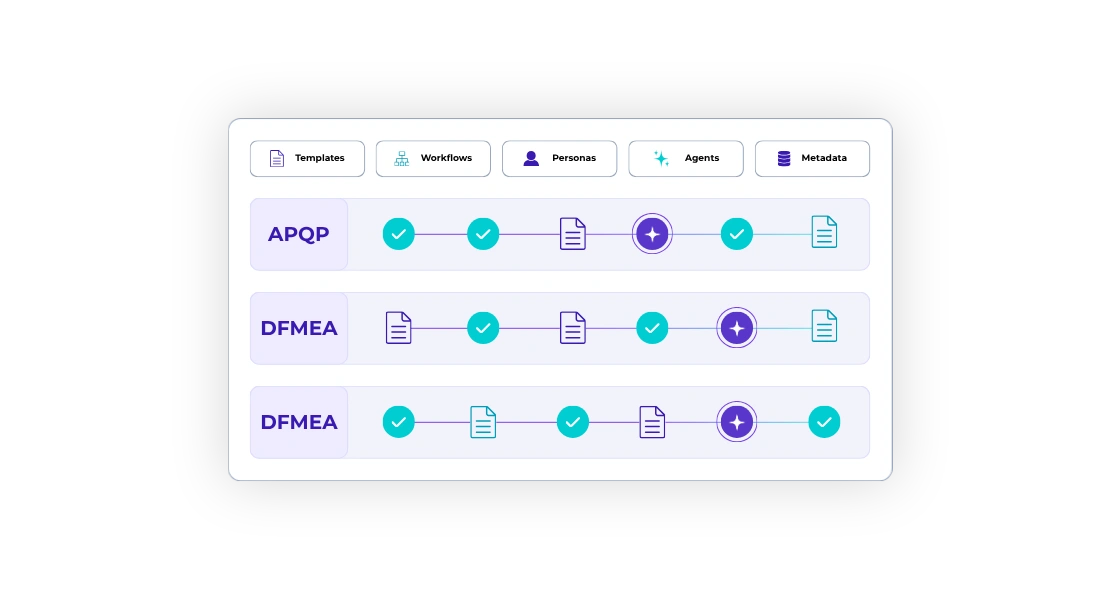
Narratize is expanding admin workflow and agent configuration so hub and group administrators can build, assign, and manage more of their operating model directly. This includes the stages, roles, agents, decision criteria, inputs, outputs, and views that make the methodology actionable across hubs.
This is distinct from the self-serve Custom Template Builder, a later roadmap capability for defining a template’s questions and output format without Narratize implementation support. Customer-specific templates can already be built from real examples, and the live library includes product-development, stage-gate, compliance, risk, technical, and communication templates.
Narratize is productizing opinionated packages for:
Scientific communication and clinical-documentation workflows can already be configured for consumer-product environments. These packages build on the same Product Knowledge Hub, workflow, evidence, and agent architecture rather than creating disconnected point solutions.
Risk analysis and readiness decisions often depend on application history, failure mechanisms, process boundaries, supplier experience, and prior trade-offs that are not fully documented. Teams can capture targeted expert answers, use interview templates, and ingest recorded interviews today.
Guided asynchronous expert interviews are in build to ask contextual follow-up questions, manage due dates, and preserve the resulting expertise as governed knowledge connected to the relevant requirement, risk, control, or decision.
Gate Deck and other presentation-oriented templates can organize the evidence today. Native PowerPoint generation is in build to turn approved hub knowledge into editable decks with charts, diagrams, flowcharts, comparison tables, RACI matrices, timelines, and supporting evidence context.
The objective is not faster slide decoration. It is a presentation that remains grounded in the same current product knowledge and decision record as the underlying workflow.
Narratize is not positioned as a wholesale replacement for specialized PLM, QMS, laboratory, or transactional systems. It provides the intelligence and decision layer that connects the methodology’s evidence, expertise, deliverables, and rationale across those systems.
The most credible first deployment is a specific decision path, such as:
Model the objects, relationships, evidence standards, owners, and exceptions required for that path. Prove that it improves the work, then scale the pattern.
Bring one methodology-critical workflow and the templates the team actually uses. Narratize can map the live operating model, near-term package, and integration requirements. Schedule a methodology workshop.
Schedule a demo and watch your team's expertise become intelligence the whole organization can use.