
Blog
Decades of design rationale are one retirement away from gone. How structured knowledge capture preserves the why behind your products.

Advanced manufacturers can see the expertise cliff coming. HR can tell you exactly how much experience walks out in the next 36 months. What doesn’t have a date is the moment that knowledge stops being available — because that moment usually passes unnoticed, mid-project, when someone asks a question no one left can answer. The files stay. The why leaves.

Documentation captures decisions. It rarely captures the rationale behind them, the alternatives considered and rejected, the constraints that forced the trade-off, or the failures that taught the lesson.
That’s exactly the knowledge a successor needs. Without it, teams face two bad options: re-run old experiments to rediscover the constraints, or proceed on assumptions and quietly violate limits the original designer understood and never wrote down. The first costs a quarter. The second can cost a recall.
Ask any engineering leader about the last time a “simple” change broke something, and the story usually ends the same way: the reason the original design looked that way was in somebody’s head.
A two-hour exit interview cannot download a career. Structured, ongoing capture can preserve the parts that matter.
Narratize’s Knowledge Capture runs guided sessions with your experts, built around the categories most often lost:
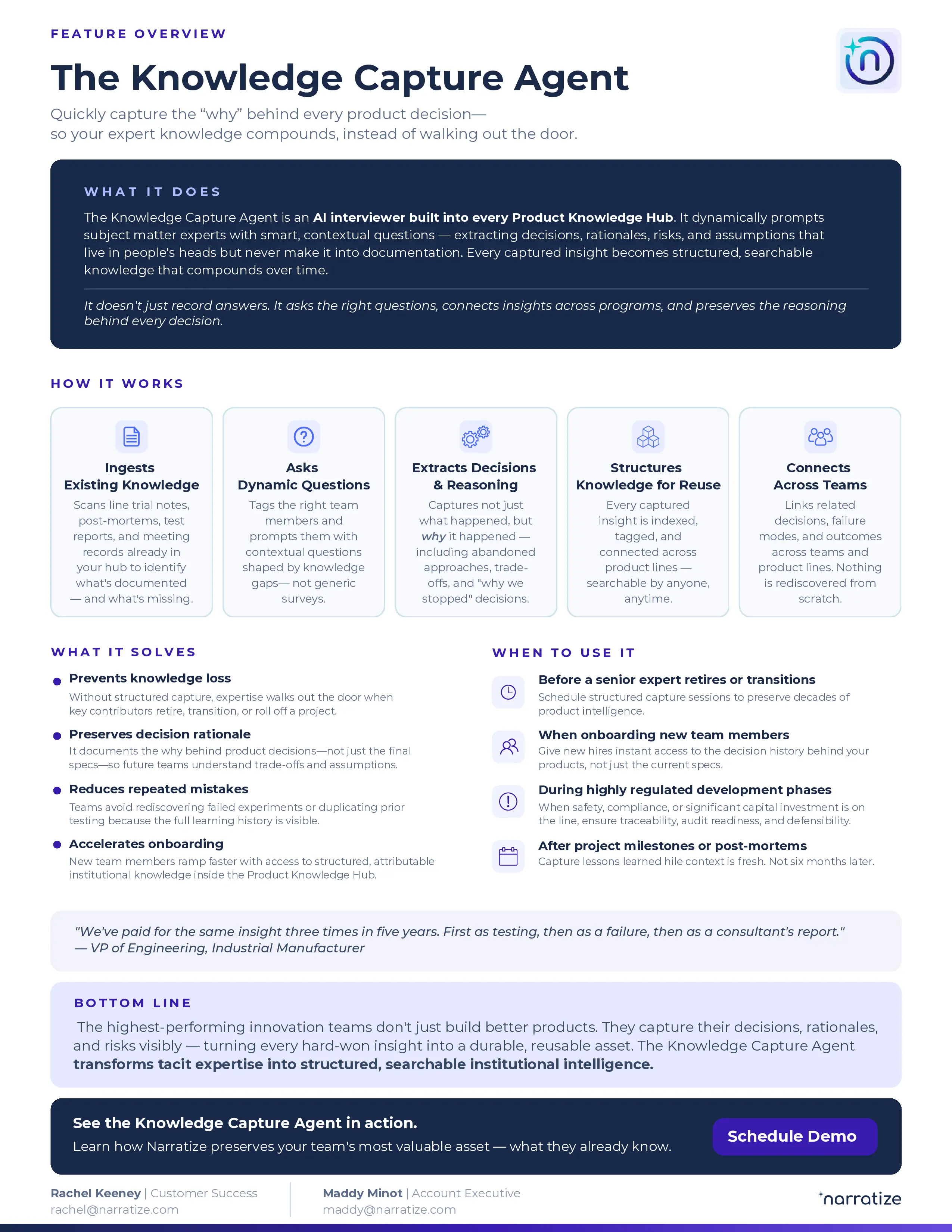
The conversations become structured, searchable knowledge in the hub the day they’re recorded. From that point on, the expertise behaves like any other governed knowledge: it appears in search results, surfaces during document creation, and gets cited by name — the lead engineer explained this in a capture session — so future teams can weigh the source.
Agents draw on it too. The Red Team Agent references documented past failures when challenging a new plan. Gate materials cite expert input as evidence. The captured knowledge doesn’t just sit; it works.

The organizations that get this right treat expertise capture as continuous engineering practice rather than an offboarding task: sessions scheduled across senior staff, prioritized by retirement risk and program criticality, feeding hubs their teams query daily.
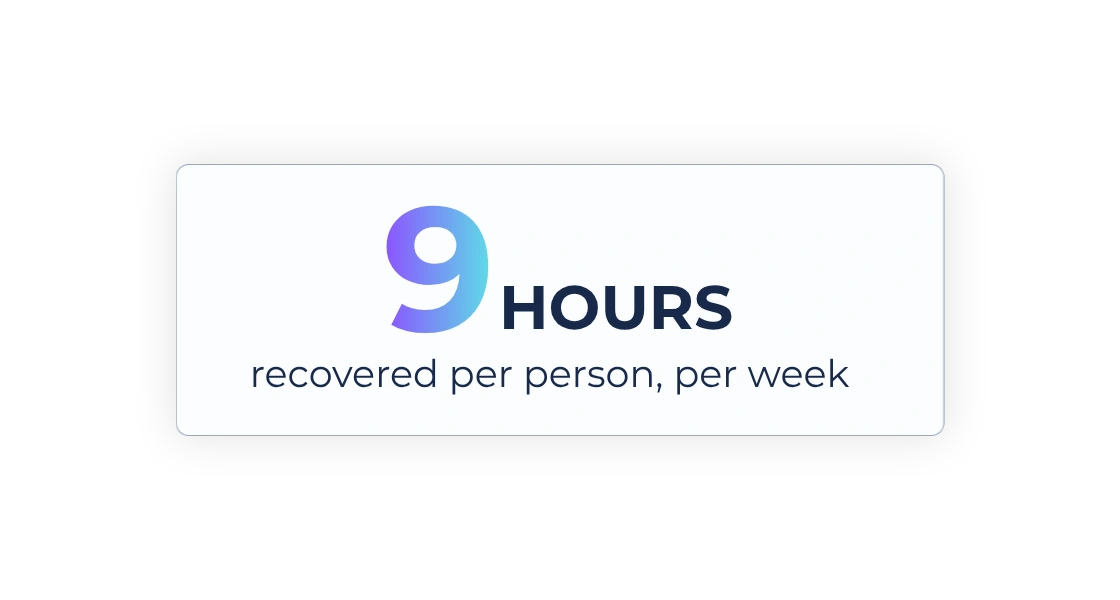
The output isn’t an archive nobody opens. It’s answers — a younger engineer asks why a legacy design carries a particular margin, and the original designer’s reasoning comes back, cited. Across customer programs, teams recover roughly 9 hours per person per week that was previously used to go to hunting for knowledge someone already had.
Start with your five most at-risk experts, and start before the calendar decides for you.
Every captured session makes the next program faster, the next hire quicker to ramp, and the next retirement a transition instead of a loss. The retirements still happen; the knowledge stops leaving with them.
That compounding is why capture is worth starting when it isn’t yet urgent. The sessions you run this quarter are the ones that answer questions three years from now — and the expert who is available today is the one who won’t be.
Sessions are structured and focused on one knowledge category at a time, which is what makes them repeatable rather than a single overwhelming download. Most programs run them on a recurring cadence with senior staff instead of concentrating the burden near a departure date.
Two factors: retirement or transition risk, and how critical their programs are to current revenue. The intersection is your starting list, and five people is a realistic first cohort.
Then you’re working from the documentary record, which is the more expensive position — and the argument for starting with the people still here. Where colleagues retain partial context, capture sessions with them recover some of the reasoning, but not the depth a session with the original engineer would have preserved.
Map your at-risk expertise and see a capture session end to end. Schedule a Discovery Call.
Connect expert reasoning to the product development documentation your team already maintains. Record which product requirements a decision supports, the alternatives considered, and the evidence that could change the decision. Explore the application to engineered systems product development.
Schedule a demo and watch your team's expertise become intelligence the whole organization can use.