
Blog
Connect each regulatory obligation to its applicability decision, product requirement, evidence, conclusion, approval, and change history.

Compliance work becomes expensive when a team has to reconstruct why a requirement applied, how it changed the product, which evidence supported the conclusion, and who approved the result.
What is compliance evidence traceability? It is the connected record from a regulatory, standards, customer, or internal obligation to its applicability decision, product requirement or control, verification evidence, conclusion, approval, and subsequent change.
A complete document set can still have a broken evidence chain. The source obligation may be in one system, the design response in another, the test report in a project folder, the approval in email, and the rationale only in an expert’s memory.
Compliance readiness is not the existence of required documents. It is the ability to trace an applicable obligation through the product decision, evidence, conclusion, approval, and change.
The regulation, standard, customer requirement, internal procedure, or market commitment—including jurisdiction, version, effective date, and source.
Why the obligation applies, does not apply, or applies conditionally to this product, intended use, market, claim, facility, or lifecycle stage. Record the accountable expert and assumptions behind the interpretation.
The design input, process control, labeling requirement, documentation obligation, risk control, supplier requirement, or other product-development response.
What will demonstrate conformity: analysis, inspection, test, review, qualification, validation, supplier evidence, literature, or another accepted method.
The executed method, configuration, data, deviations, report, and record version. A conclusion without the tested product state is difficult to reuse or defend.
Whether the evidence supports conformity, reveals a gap, requires mitigation, or remains insufficient. Preserve limitations, residual uncertainty, and required follow-up.
Who reviewed and approved the conclusion, which exceptions were accepted, and what changes require reassessment.
When these seven elements are connected, audit and submission preparation become retrieval and review. When they are not, teams infer the chain after the people and context have moved on.
Add small capture points where the work already happens:
Structured templates help by asking the required questions consistently. They do not make an answer correct by construction. The accountable technical, quality, regulatory, or legal reviewer still determines whether the evidence and interpretation are adequate.
Early development may rely on preliminary literature, prototypes, engineering analysis, or expert judgment. Later stages may require controlled methods, representative samples, approved protocols, reproducible data, and formal review.
Label the maturity of the evidence:
This prevents a technically true early finding from being reused later at a level of certainty it never earned.
For medical-device manufacturers, the FDA’s Quality Management System Regulation became effective on February 2, 2026 and incorporates ISO 13485:2016 by reference into 21 CFR Part 820. The specific obligations differ by product and quality system, but the operating implication is broadly relevant: evidence and quality-system records must remain connected to the processes and decisions they support. Review FDA’s QMSR overview.
Aerospace, chemicals, consumer products, electrical equipment, and other regulated sectors use different frameworks. The evidence-thread structure still applies; the applicable obligations, decision rights, and record controls must be configured for the actual domain.
Product Knowledge Hubs organize requirements, standards, specifications, risk work, test records, quality evidence, decisions, and expert contributions in one governed product context. Source-linked chat and generation help reviewers inspect the evidence behind a statement. Version history, approvals, workflow state, override records, and document lineage preserve how the work changed.
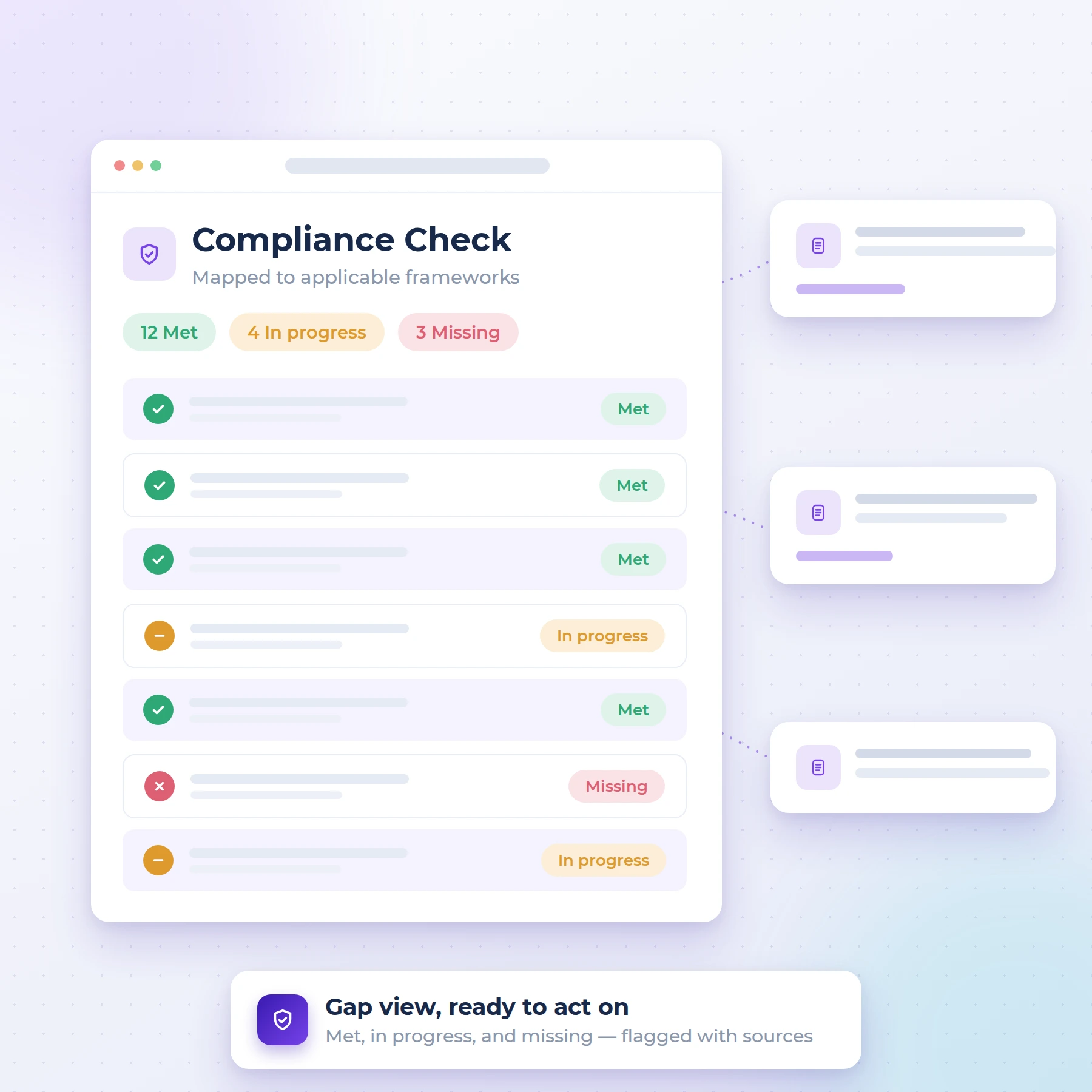
The live Compliance Verification Agent evaluates documentation against applicable frameworks—including FDA, ISO, CE, REACH, ATEX, IEC, UL, and other configured domains—and reports met, unmet, and in-progress requirements with supporting evidence. Alignment Checker surfaces conflicts across product documents. The named Red Team Agent challenges assumptions before a controlled decision. StageGate Decision and Readiness assesses whether the required evidence is sufficient for the configured gate.
Organization-level workflows can encode the stages, inputs, outputs, approvals, and exception paths required by the company’s quality or development method. Narratize is expanding broader self-service workflow and agent configuration for hub and group administrators, as well as packaged support for APQP, DFMEA, NPI, engineered-system documentation, and medical-device design and development workflows.
The Market Intelligence Agent can investigate current regulatory developments now, and Compliance Verification can assess the product documentation against selected frameworks. Narratize is extending this foundation into live regulatory alerts: high-priority changes can be connected to the relevant hubs, requirements, markets, and owners so the team can review applicability and impact before a gate or launch.
That does not make Narratize a legal authority or automatically determine applicability. The value is a faster, governed path from external change to accountable review and documented disposition.
Targeted expert questions, interview templates, and transcribed audio or video can capture rationale that is absent from the formal record. Guided asynchronous expert interviews are being added to structure follow-up questions, deadlines, expert responses, and the resulting knowledge object.
Current source connections include point-in-time files from OneDrive, SharePoint, and Google Drive, plus Jira, Confluence, and Aha! ingestion and live MCP access. Broader direct connectors to PLM, ERP, LIMS, and other enterprise systems are part of the expanding Integration Layer, enabling more automated movement between authoritative records and the compliance evidence thread.
Select one consequential requirement and ask:
Every broken link is a specific remediation target. This is more actionable than asking whether the documentation is broadly “audit-ready.”
The desired result is not zero uncertainty. It is a visible, reviewable account of what the organization concluded, on what evidence, for which product state, and under whose authority.
Bring one requirement and the records currently used to support it. Narratize can map the evidence thread and show where compliance work is becoming reconstruction. Schedule a compliance-evidence workshop.
Schedule a demo and watch your team's expertise become intelligence the whole organization can use.