
Blog
Make formulation decisions, scale-up learning, negative results, and expert knowledge reusable across chemicals and advanced-materials R&D.
In formulation and advanced-materials R&D, a result is not reusable simply because the report can be found. A future team needs to know the exact composition, material grades, method, equipment, scale, sequence, environment, result, confidence, and reasoning that made the conclusion valid.
What should an R&D formulation decision record contain? It should capture the question, formulation or material state, processing conditions, evidence and method, alternatives, decision and rationale, observed outcome, applicability boundary, owner, and triggers for reconsideration.
This is the difference between storing experimental documents and carrying technical intelligence forward.
“We tried that” is not reusable scientific knowledge. Reuse begins when another qualified person can tell what was tried, under which conditions, what happened, why the team decided as it did, and whether the result applies now.
Several characteristics make formulation and materials work especially context-sensitive:
A semantic search result can be relevant by topic and still be scientifically inapplicable. Retrieval must preserve conditions and evidence maturity.
Not every experiment requires a long narrative. The fields can be concise. Their purpose is to preserve the scientific and decision context the raw result cannot carry alone.
Distinguish among:
Each classification leads to a different future action. A technically unsuccessful route may be worth revisiting after a process change; a disproven mechanism may not. An inconclusive method should not become a negative product conclusion.
Ask experts about a specific decision, observation, or boundary:
Pair the answer with the relevant formulation, experiment, source record, and decision. This makes expertise reviewable rather than turning it into an isolated oral-history archive.
Product Knowledge Hubs can organize research reports, spreadsheets, presentations, images, technical specifications, test records, supplier documents, meeting decisions, websites, and expert contributions for a formulation, product, technology platform, or research topic.
Audio and video can be transcribed during ingestion. AI-generated metadata, organization tags, source instructions, expiration dates, and knowledge state support curation. Teams can ask source-linked questions within one hub or across permitted hubs, save individual answers as knowledge, and preserve generated and authored documents with versions and lineage.
Live agents support scientific and product decisions:
Structured Write templates support feasibility studies, risk assessments, specifications, manufacturing analyses, test and validation reports, after-action reviews, post-mortems, research reports, and technical communications. Workflows can place each input and output at the relevant stage with approvals and exception handling.
A global tire manufacturer brought historical research, test results, and decision rationale into Product Knowledge Hubs to support hypothesis development and literature synthesis. In a pilot involving nine people across four Rapid Learning Cycles, the team reported 4.6× faster learning cycles and 85% fewer engineering hours for the evaluated work.
For formulation and materials teams, the useful connection is the research workflow: assemble what is already known, understand the reasoning behind earlier conclusions, and use that context to frame the next investigation. The reported figures describe the pilot’s learning work; formulation performance and scale-up outcomes require their own experimental evidence.
Targeted expert questions, interview templates, and recorded-interview ingestion are available today. Guided asynchronous expert interviews are in build to add categorized question banks, scheduling, contextual follow-up, expert-facing completion, and a distinct governed knowledge type.
For formulation teams, the interview can be triggered by a knowledge gap, scale-up review, formulation change, repeated failure, transfer, or pending departure. The value lies in connecting the expert’s answer to the product context and decision it affects.
Current connections support point-in-time files from OneDrive, SharePoint, and Google Drive; Jira, Confluence, and Aha! ingestion; direct uploads and URLs; and live MCP access. These allow relevant scientific evidence to enter the governed decision context while the laboratory or enterprise system remains authoritative.
Narratize’s Integration Layer is expanding through Power Automate and deeper connector orchestration. Direct LIMS, ELN, PLM, ERP, formulation, and two-way system connections are part of the broader roadmap. A credible integration should specify whether the platform is retrieving a report, structured result, formulation object, metadata, or approved output—and how source identity and revision remain visible.
The Market Intelligence Agent can investigate current regulatory and standards developments now. Narratize is extending this into live regulatory alerts that connect relevant changes to affected materials, ingredients, markets, claims, products, evidence, and owners.
The system should accelerate detection and impact review, not replace qualified scientific, safety, regulatory, or legal interpretation.
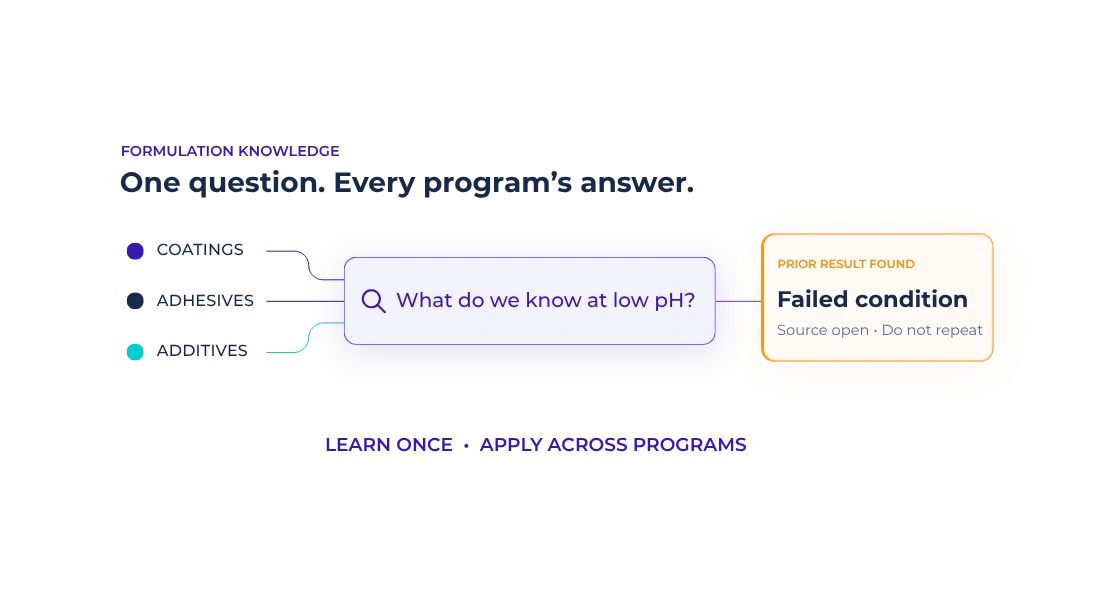
Cross-Hub Chat supports permitted questions across programs today. Portfolio Intelligence is in build to add product and program health, stage progression, evaluation summaries, Knowledge Readiness scoring, reliability signatures, and natural-language questions across hubs.
For scientific portfolios, useful questions include:
Advanced portfolio analytics should identify candidates for review, not automatically declare scientific equivalence across conditions.
Source-grounded documents and Word or PDF export are available now. Native PowerPoint generation is in build so technical reviews, transfer packs, gate decks, literature summaries, and executive updates can be generated as editable presentations from governed hub knowledge.
That preserves one evidence base across scientific work and leadership communication instead of forcing teams to recreate the meaning in a disconnected slide deck.
The objective is not to eliminate repetition. Replication can be scientifically necessary. The objective is to ensure the next experiment begins with the full intelligence of the work already done.
Bring one formulation or materials decision the organization has revisited across programs. Narratize can map the experimental evidence, context, expert knowledge, and applicability boundaries required to make it reusable. Schedule a formulation knowledge workshop.
Schedule a demo and watch your team's expertise become intelligence the whole organization can use.